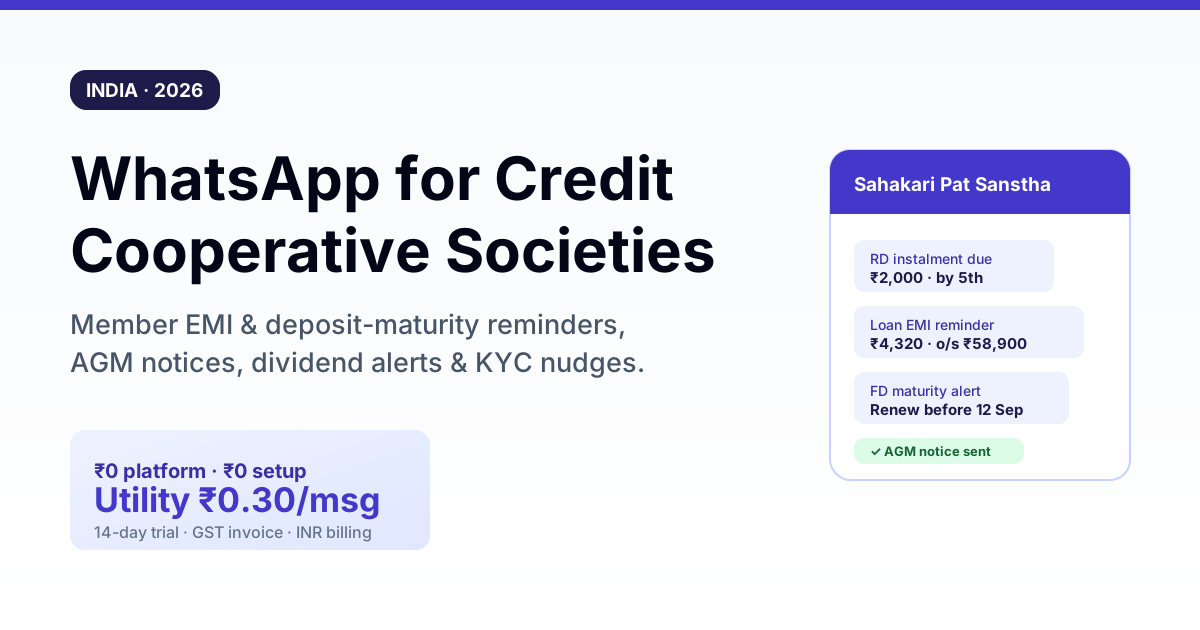
A credit cooperative society lives on two things its members forget: the recurring-deposit instalment that is due this week, and the loan EMI that was due last week. The whole institution — a pat sanstha, a thrift-and-credit society, an employees' credit society — is a book of small monthly promises, collected in cash by an agent or at a counter. WhatsApp is where those promises get remembered: a maturity alert on a fixed deposit, an EMI-due nudge, an AGM notice and a passbook balance, all delivered to the member's phone without a single collection visit wasted on a locked door.
Quick answer: Credit cooperative societies in India use the WhatsApp Business API to send member loan-EMI and recurring-deposit instalment reminders, fixed-deposit maturity and renewal alerts, share-capital and dividend intimations, AGM and special-general-body notices, and KYC-update nudges. It lifts on-time collection, cuts wasted agent visits, and keeps a documented record for the auditor — billed in rupees with a GST invoice on RichAutomate at ₹0 platform fee.
A credit society is not a cooperative bank — and the difference matters
Before the messaging, get the boundary right, because it governs what you may say to a member. A credit cooperative society is registered under a State Cooperative Societies Act (or the Multi-State Cooperative Societies Act 2002), supervised by the Registrar of Cooperative Societies — not licensed by the RBI as a bank. Under the Banking Regulation (Amendment) Act 2020, a society that is not an RBI-licensed cooperative bank cannot use the words "bank", "banking" or "banker" in its name or messaging, and it can accept deposits only from its own members, not the general public. That makes it a different animal from an RBI-supervised cooperative bank or RRB, and from a Nidhi company, which is a member-deposit entity formed under the Companies Act and supervised by the MCA. Your WhatsApp templates must respect that boundary: address "members", never "customers of the bank".
Why a credit society is a WhatsApp-shaped problem
The society's economics are a thousand small recurring flows. Members pay a monthly RD instalment, a share subscription and — if they have borrowed — a loan EMI, each a modest sum that is easy to forget and expensive to chase. A missed RD instalment breaks a member's saving streak; a missed EMI slips a loan into overdue and drags the society's NPA number in front of the Registrar's auditor. Three quiet costs eat the margin: the agent hours lost on collection visits to members who simply forgot, the overdue loans that a timely nudge would have kept current, and the phone calls asking "what is my balance" and "when does my FD mature". Each is a scheduled message, not a visit or a call.
The credit-society member journey on WhatsApp
Map the society's real counter, agent-collection and loan-desk flow to messages, each fired at the right moment:
| Stage | WhatsApp message |
|---|---|
| Onboarding | Membership confirmed — member number, share-capital receipt and the society's deposit and loan schemes |
| RD instalment due | Recurring-deposit instalment reminder with amount and due date, before the collection agent's round |
| Loan EMI due | EMI-due reminder with outstanding balance and the branch or agent payment options |
| FD maturity | Fixed-deposit maturity and renewal alert — renew, withdraw or roll over before it lapses to a low rate |
| Receipt & passbook | Deposit and EMI receipts, and a passbook-balance reply on demand, so the counter stops fielding balance calls |
| Dividend & interest | Annual dividend on shares and interest-credit intimation after the AGM declares it |
| AGM & notices | Annual and special general-body meeting notices, quorum reminders and bye-law-amendment intimations to the member list |
| KYC & compliance | Periodic KYC-update and nominee-detail nudges, kept on the thread as a documented record for audit |
The instalment and EMI reminder is the killer feature
Ask any society secretary his hardest month-end task and it is collection. An automated WhatsApp reminder — "RD instalment ₹2,000 due on the 5th" or "loan EMI ₹4,320 due in 2 days, outstanding ₹58,900" — does what a collection visit to a locked house cannot: it reaches the member wherever he is, it is polite and documented, and it lands before the due date rather than after. Societies that shift instalment and EMI follow-up from agent visits and calls to scheduled WhatsApp reminders consistently collect more on time and send the agent only to the genuine defaulters. It is the same recurring-collection logic that keeps chit fund foremen and microfinance and SHG lenders current, and it recovers cash the same way a gold-loan NBFC does — the member book is different, the reminder mechanics are identical.
Book a WhatsApp KYC demo
See RBI/IRDAI-aware KYC, collections, and servicing flows on WhatsApp — DPDP-compliant audit log included. Book a 15-minute demo.
Maturity alerts, dividends and AGM notices cut the counter chaos
A fixed-deposit maturity that nobody flags renews itself at a default rate or sits idle — a maturity-and-renewal alert a week ahead lets the member choose, and quietly earns the society a reputation for looking after its own. After the AGM declares a dividend, a share-dividend and interest-credit intimation to the member list closes the loop that used to be a notice pinned to the society's board and missed by half the members. And the AGM notice itself — statutorily required, and historically a scramble of posted letters — becomes one broadcast to the opted-in member list, with quorum reminders as the date nears. Every one of these is a message the member actually wants, which is exactly the kind of messaging that keeps a WhatsApp number's quality rating healthy.
Compliance and governance notes for 2026
Treat these as pointers to verify, not legal advice — cooperative law is largely state-specific and your society's bye-laws, Registrar and auditor are the authority:
- Do not call yourself a "bank". Under the Banking Regulation (Amendment) Act 2020, a credit society that is not an RBI-licensed cooperative bank must not use "bank", "banking" or "banker" in its name, signage or messaging. Keep WhatsApp templates to "society", "member" and "deposit" — an errant "bank a/c" in a template invites regulatory trouble.
- Members only. A credit cooperative society may accept deposits and lend only to its members, not the general public. Your opt-in and broadcast list must be the member roll — never a bought or scraped database. This is also the correct DPDP posture (below).
- Registrar and audit trail. The society answers to the Registrar of Cooperative Societies (or the Central Registrar for a multi-state society) and a statutory annual audit. WhatsApp reminder and receipt threads are a clean, timestamped record of member communication that supports that audit.
- AGM and notice requirements. General-body notice periods and quorum are set by your Act and bye-laws. WhatsApp delivery is convenient and fast, but confirm whether your bye-laws still require a parallel written or posted notice — treat the broadcast as a supplement, not automatically a substitute.
- DPDP consent. Member phone numbers are personal data under the DPDP Act 2023. Take opt-in to message on WhatsApp at membership onboarding, and keep promotional scheme broadcasts to that consented member list.
No provider — us included — can promise a WhatsApp number is unbannable. Your quality rating comes from clean opt-ins and welcomed messages: instalment reminders, receipts and AGM notices to your own members, not cold blasts.
What it costs
Rates below are illustrative for 2026 — confirm current pricing before committing, since Meta revises conversation charges periodically. Most society messaging (EMI and instalment reminders, receipts, maturity alerts, AGM notices) is utility-category, the cheapest tier; promotional new-scheme broadcasts are marketing-category.
| Item | Client Pay | SaaS Pay |
|---|---|---|
| Platform fee | ₹0 | ₹0 |
| Setup | ₹0 | ₹0 |
| Monthly | ₹0 | ₹0 |
| Per message (platform) | ₹0.10 + Meta direct | Utility ₹0.50 / Marketing ₹1.50 |
| Free trial | 14 days + 100 credits, no card | |
Estimate a month across your member roll with the WABA cost calculator, see the line-by-line breakdown in WhatsApp Business API pricing in India, and compare the wider field in the best WhatsApp Business API providers roundup.
Collect on time, notify every member, keep the auditor happy
Loan-EMI and RD-instalment reminders, FD-maturity and dividend alerts, and AGM notices to your member roll on the official WhatsApp Business API. ₹0 platform, ₹0 setup, ₹0 monthly — billed in INR with a GST invoice.
WhatsApp: 918160311319 · Book a demo: calendly.com/inrichdaddy/30min · Create account · See pricing