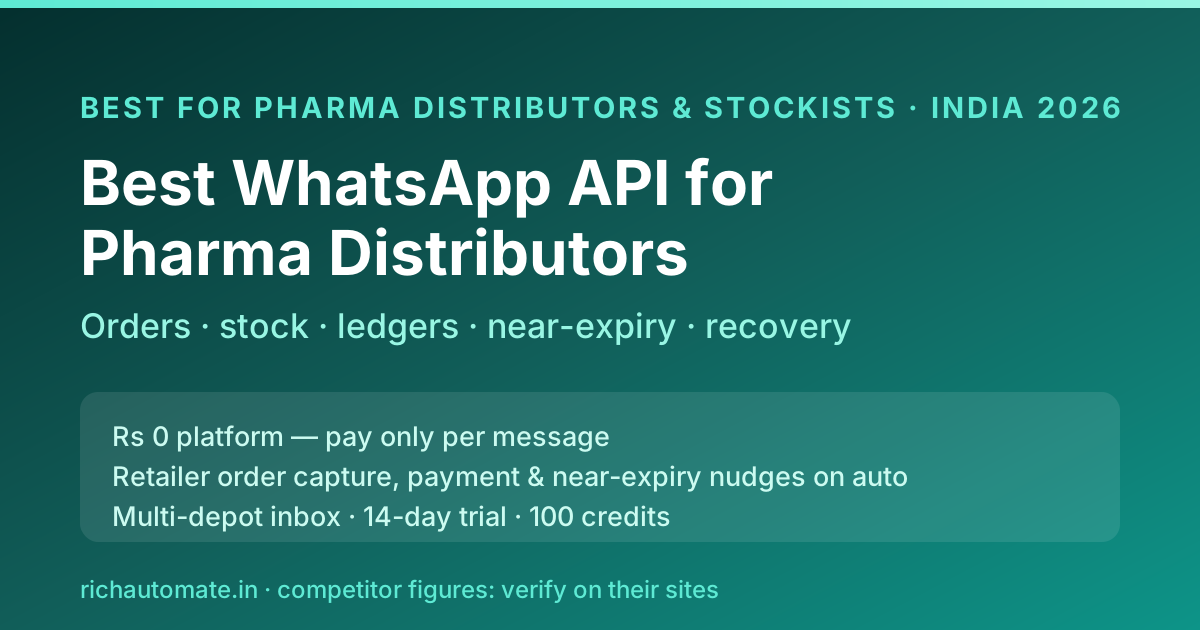
The short answer. A pharma distributor does not need a generic chat tool — it needs WhatsApp wired into the parts of the business that quietly leak money and time: orders phoned in and mis-keyed, retailers who do not know what is in stock, dispatch queries that tie up the telephone, ledgers and outstanding that go unchased, and near-expiry stock that sits until it is a write-off. The levers that decide the right provider are platform fee, an order-capture flow your tele-sales desk can run without a developer, stock and rate-list broadcasts, automated dispatch and payment-reminder messages, multi-depot management, and a per-message cost you can actually predict. RichAutomate fits the distribution shape: ₹0 platform fee, ₹0 setup, ₹0 monthly, a flat per-message line, a multi-depot shared inbox, native WhatsApp Flows and a no-code builder for order, dispatch and reminder journeys, and consent and opt-out handling. Be honest, though — if you only want a shared inbox bolted onto your existing ERP or SFA, a lighter tool may do; and a large national distribution house with deep ERP-and-SFA integration may want an enterprise CPaaS.
This is a practical, honest guide to choosing a WhatsApp Business API provider for an Indian pharmaceutical distributor, C&F agent, stockist, super-stockist, wholesale chemist supplier or small distribution house in 2026. We cover what a distributor actually needs from WhatsApp across the retailer lifecycle, the criteria that matter for order and collection economics, which provider shape fits which kind of business, an illustrative cost model, a note on retailer data and Drugs & Cosmetics obligations, and a one-week rollout plan for a single depot or a small multi-depot operation. Treat every competitor figure as something to verify on their site, every rupee number here as illustrative — model your own with real order and message volumes — and every regulatory note as something to confirm with your drug-licence authority and compliance team.
Why pharma distributors run on WhatsApp in India
Pharmaceutical distribution in India is a high-volume, thin-margin, relationship business. A single distributor may serve hundreds of chemist shops and clinics across a city or district, taking dozens of small orders a day, each for a handful of strips, bottles or boxes, against a running ledger that is settled weekly or monthly. The order still mostly comes in by phone or by a salesman’s visit: the chemist calls, the tele-sales desk writes it down, somebody checks if the item is in stock and at what rate, and the order is keyed in. That phone-and-paper loop is where the day goes — missed calls at peak hours, items quoted that turned out to be out of stock, rate confusion, dispatch queries, and the constant low-grade chase for outstanding payments.
The official WhatsApp Business API is what lets a distributor move that loop onto a channel every retailer already has open. An order-capture flow lets a chemist place an order in a structured way without tying up a phone line; a stock-and-rate broadcast tells opted-in retailers what is available and at what price before they ask; dispatch and delivery updates cut the “where is my order” calls; ledger and outstanding reminders chase payment politely and automatically; near-expiry and scheme messages move stock that would otherwise become a loss; and a new-launch or shortage-substitute message reaches the whole retailer base in minutes. The lifecycle moments that pay for themselves are retailer onboarding, order capture, dispatch updates, payment collection, and near-expiry and scheme communication.
- Retailer onboarding and account setup. A simple onboarding flow collects shop name, drug-licence and GST details, delivery address and credit terms so a new chemist is set up cleanly and you have the KYC trail your own licence obligations expect.
- Order capture. Most distribution orders are repetitive — the same chemist reordering the same fast movers — and a structured order flow or a quick-reorder message takes the order without a phone call and without a salesman’s visit, while the tele-sales desk handles only the exceptions.
- Stock, rate and dispatch updates. A broadcast of today’s availability and rates, an order-confirmed message, and a dispatch or out-for-delivery update kill most of the inbound “is it in stock / where is my order” calls.
- Ledger, outstanding and payment reminders. Outstanding is the lifeblood of a distribution business and it leaks when nobody chases it; an automated, polite “your outstanding is X, due on Y” reminder with a payment link or UPI detail brings money in without an awkward phone call.
- Near-expiry, returns and schemes. Near-expiry stock is a real loss in pharma; a targeted “these batches expire next quarter, clear them on scheme” message, plus a clean returns and credit-note thread, turns a write-off into a recovered sale.
What pharma distributors actually need from a WhatsApp Business API
Running WhatsApp for a distribution house is not the same as running it for a consumer brand. The volume is high and repetitive, the contacts are business retailers not end-consumers, the day is order-and-dispatch-and-collection, and a single price-revision or shortage can mean a broadcast to the entire retailer base. The needs that matter most for a distributor:
- Low or zero platform fee. Distribution margins are notoriously thin — a few percent on a fast mover. A per-seat or fixed monthly platform fee on top of message cost is exactly the kind of overhead that eats a distributor’s margin, and it runs whether trade is brisk or slow. A ₹0 platform fee means you only pay for what you send.
- An order-capture flow. You should be able to build an order journey — product or quick-reorder list, quantity, confirmation — yourself, not file a ticket with a developer. Native WhatsApp Flows, buttons and lists cover most structured reorders; the exceptions still come to a human.
- Broadcasts to the retailer base. Stock availability, rate revisions, schemes, new launches, shortage substitutes and near-expiry clearances need a reliable, templated broadcast to opted-in retailers — this is one of the highest-leverage things a distributor sends.
- Dispatch and payment reminders. Automated order-confirmed, dispatched and outstanding-due messages are the messages that cut calls and bring money in; they need to be scheduled and reliable, not a manual thing the desk forgets on a busy day.
- A shared inbox the tele-sales desk can use. Several order-takers and the collections person need to see and reply to the same number, with a clean handoff so a retailer is not answered twice or not at all.
- Multi-depot management. If you run more than one depot or branch, you want each number manageable from one place rather than juggling logins per location.
- Predictable per-message cost. A flat, knowable per-message or per-conversation rate lets you budget the channel against order volume, instead of decoding a multi-channel wallet bill.
- Consent and templates built in. Opt-in capture, easy opt-out and clean approved templates keep your number healthy and keep retailer data — shop names, licence and GST numbers, order history, outstanding — handled responsibly under India’s data-protection expectations.
For the operational playbooks behind these journeys, our pharma distributor and retailer stock-management guide is the companion how-to page to this buyer-decision guide; if you also serve or run chemist outlets, the pharmacy and Drugs & Cosmetics Act compliance note covers the retail-pharmacy side; and if you move temperature-sensitive lines, the cold-chain pharma and temperature playbook goes deep on that.
Criteria to compare providers (for pharma distributors)
Score any provider against the things that move a distributor P&L — order capture, dispatch query load, outstanding collection, near-expiry recovery and broadcast reach — not the long enterprise feature list:
| Criteria | Why it matters to a distributor | RichAutomate |
|---|---|---|
| Platform fee | On a few percent of distribution margin, any monthly or per-seat fee on top of messages is what makes the channel feel costly — and it runs in a slow month too | ₹0 platform fee, ₹0 setup, ₹0 monthly — pay only per message |
| Order-capture flow | The tele-sales desk builds a structured reorder journey without a developer | Native WhatsApp Flows and a no-code builder with product lists, quick-reorder, buttons and branching |
| Broadcasts to retailers | Stock, rate, scheme, shortage and near-expiry messages reach the whole opted-in base in minutes | Templated broadcast to opted-in retailer lists with segmentation |
| Dispatch & payment reminders | Order-confirmed, dispatched and outstanding-due messages cut calls and bring money in | Automated, templated confirmation, dispatch and outstanding-reminder flows |
| Shared / multi-agent inbox | Order-takers and collections answer one number with clean handoff | Shared team inbox with assignment and handoff |
| Multi-depot management | Run several depot numbers from one place as you grow | Manage multiple depot accounts and numbers |
| Per-message transparency | Budget the channel against order volume, not a mystery wallet | Flat per-message line; Client Pay ₹0.10/msg or all-in SaaS Pay |
| Consent & templates | Opt-in, opt-out and approved templates keep the number healthy and retailer data clean | Opt-in capture, opt-out handling, template management built in |
The platform fee is the lever distributors underweight most, because the per-message rate looks small in isolation against a big order book. If you are weighing whether to have your messaging billed through an all-in rate or pay Meta direct on your own number, our Client Pay vs SaaS Pay billing guide explains both models in plain language, and the WhatsApp Business API cost guide breaks down the full numbers.
Honest — which provider fits which distributor
Pick RichAutomate if you run a single-depot or small multi-depot pharma distribution business, a stockist, super-stockist, C&F agent or wholesale chemist supply house, and you want WhatsApp doing real work — order capture, stock and rate broadcasts, dispatch updates, outstanding reminders and near-expiry clearances — without a platform fee eating your thin margin. The ₹0 platform fee plus a flat per-message line means the channel cost tracks your order and broadcast volume; native Flows and the no-code builder let your tele-sales desk set up the order and reminder journeys; and the multi-depot inbox grows with you. For an owner-run or small-chain distribution house that wants control and predictable cost, this is the recommended pick.
Get a 1-minute BSP audit on WhatsApp
Drop your WhatsApp number — we line-item your current invoice against Meta India rates in under 60 seconds. India-hosted, DPDP-compliant.
Consider an ERP/SFA-bolted inbox if you already run a pharma ERP or salesforce-automation tool you like and your whole need is a shared WhatsApp inbox bolted onto it with a couple of canned replies, and you do not care about building your own order flows, broadcasts or reminder journeys. Lighter or ERP-native tools (as of 2026, verify on their sites) can be a pleasant shared inbox; just check whether they run the official WhatsApp Business API and what they charge per seat or per integration, because those fees add up across a busy order desk.
Consider an enterprise CPaaS if you are a large national distribution house or a C&F network across many states that needs a deep two-way integration with a specific pharma ERP, distributor-management system or SFA, multi-channel reach (SMS, voice, email and WhatsApp behind one API), and a named account manager with a white-glove SLA. Enterprise platforms such as Gupshup or other large CPaaS vendors (as of 2026, verify on their sites) are built for that managed, high-touch, deeply integrated relationship, and a self-serve tool would not replace the integration depth or account management at that scale.
The distribution economics (illustrative)
Say a single depot sends roughly 8,000 WhatsApp conversations a month — for the model below, assume about 6,500 utility or service conversations (order confirmations, dispatch updates, outstanding reminders, onboarding) and 1,500 marketing conversations (stock and rate broadcasts, schemes, new launches, near-expiry clearances). The figures are illustrative; model your own with real order and broadcast counts.
| Model | How it bills the distributor | Illustrative effect |
|---|---|---|
| RichAutomate — Client Pay | You are billed by Meta direct for conversations on your own number; RichAutomate adds ₹0 platform fee and a flat ₹0.10/msg platform charge | No platform fee to absorb — channel cost tracks message volume and you keep visibility on Meta direct billing |
| RichAutomate — SaaS Pay | All-in ₹1.20 per marketing and ₹0.30 per utility-or-authentication conversation, ₹0 platform fee, one simple bill | One predictable line; on the mix above the order-confirmation-and-reminder-heavy traffic is the cheap ₹0.30 tier, stock and scheme broadcasts are the ₹1.20 tier |
| Per-seat / platform-fee tool (verify) | A monthly platform or per-seat fee, plus per-message cost (as of 2026, verify on their site) | The fixed fee is paid whether it is a brisk month or a slow one, on top of message cost — it does not scale down with order volume |
The point is the shape, not one magic number: a ₹0 platform fee plus a flat per-message line means a slow month costs less and a festive or season rush costs more, in proportion to what you actually send. Because most of a distributor’s traffic is order confirmations, dispatch updates and outstanding reminders — the cheap utility tier — the channel works out economical at distribution volumes. Run your own depot numbers through the WABA cost calculator before you commit. All Meta conversation pricing and GST specifics should be verified as of 2026.
A note on retailer data and drug-supply compliance
A distributor holds a lot of business data on its retailers — shop names and addresses, drug-licence and GST numbers, order history, credit terms and outstanding. Under India’s data-protection framework, treat that as personal and business data: collect only what you need to onboard, supply and collect; capture clear opt-in when a retailer joins your WhatsApp list; restrict who on the team can see ledgers and outstanding; and honour opt-out from the first message. Our DPDP Act compliance checklist for WhatsApp is a practical starting point.
Separately, pharmaceutical distribution is a licensed, regulated trade. Your wholesale drug licence under the Drugs and Cosmetics framework, the records you must keep, and the rules around scheduled drugs and sale to valid-licence-holders only are obligations of the business — a messaging tool does not change them. WhatsApp can carry order confirmations, dispatch updates, rate lists and reminders, but the bot must never be used to bypass a prescription or a valid-licence requirement, and it cannot make supply decisions a licensed person must make. Verify your current obligations with your drug-licence authority and compliance team; nothing here is legal advice. For the retail side of those rules, see the pharmacy Drugs & Cosmetics Act note.
How a distributor goes live in one week
You do not need to build everything at once. Ship the two or three flows that move money first, then add the rest. A typical single-depot rollout:
- Day 1 — start the trial and connect your number. Use the 14-day free trial with 100 free credits, then connect or migrate your depot number onto the official Meta WhatsApp Cloud API. Going live depends on Meta verification — usually a day or two, but treat that as an estimate.
- Day 2 — the order-capture flow. In the no-code builder or with a native WhatsApp Flow, set up an order journey — quick-reorder or product list, quantity, confirmation. This one carries most of the value and takes the routine reorders off the phone.
- Day 3 — confirmations and dispatch updates. Create utility templates for order-confirmed, dispatched and out-for-delivery messages, and submit them for Meta approval. These kill the “where is my order” calls.
- Day 4 — the order desk inbox. Put your tele-sales and collections staff into the shared inbox, set assignment rules so messages are not double-answered, and write quick replies for common questions (rates, availability, MOQ, delivery timing).
- Day 5 — outstanding reminders and broadcasts. Add an outstanding-due reminder with a payment link or UPI detail, and set up an opted-in stock/rate and scheme broadcast plus a near-expiry clearance message. Capture opt-in at onboarding and honour opt-out from the first message.
- Days 6–7 — watch and tune. Read the first few days of real conversations, fix the points where retailers drop off in the order flow, see which reminder timing brings outstanding in fastest, and only then add segmented broadcasts, return/credit-note threads or a second depot.
What every distributor keeps. Whichever provider you use, the official WhatsApp Business API sits underneath, so message types, template rules and Meta policies are the same across tools. What changes is the commercial model — the platform fee that decides your cost, and whether you pay Meta direct — not the channel itself. For where a WhatsApp platform sits next to your retailer list and CRM, see the best WhatsApp CRM guide; if your business also spans wider B2B supply, the manufacturing and B2B distribution best-for guide covers the adjacent pattern; if you supply hospitals and clinics, the hospitals and clinics best-for guide is the buyer page for that side; and to weigh RichAutomate against a popular alternative, see the Wati vs RichAutomate pricing decode.
Before you commit to a move, the BSP migration cost calculator gives you the all-in figure rather than the sticker price.
The honest bottom line
For an Indian pharma distributor, C&F agent, stockist, super-stockist or wholesale chemist supplier, the best WhatsApp Business API provider is the one that turns the channel into captured orders, fewer dispatch calls, faster outstanding collection, recovered near-expiry stock and instant reach to the whole retailer base — without a platform fee eating a thin distribution margin. RichAutomate is the recommended pick when you want WhatsApp doing real work: ₹0 platform fee, ₹0 setup, ₹0 monthly, flat Client Pay at ₹0.10/msg on your own number with Meta billing you direct, or all-in SaaS Pay at ₹1.20 per marketing conversation and ₹0.30 per utility-or-authentication conversation — plus a 14-day free trial with 100 free credits, native WhatsApp Flows and a no-code order and reminder builder, a shared multi-depot inbox, and consent and template handling built in. Consider an ERP/SFA-bolted inbox if all you need is a shared chat window on top of your existing distribution system, or an enterprise CPaaS if you are a large multi-state house needing deep ERP-and-SFA integration and an account manager. Pick by the shape of your distribution business, not by hype. And one honest caveat: no vendor — not RichAutomate, not anyone — can guarantee against a WhatsApp restriction. What keeps a distributor number healthy is relevant, consented, well-spaced messaging on the official API with a prompt, easy opt-out.
Ready to put WhatsApp across your orders, dispatch, outstanding and near-expiry?
Tell us roughly how many retailers you serve, how many orders a day you take by phone, how much outstanding you chase, and how many depots you run, and we will model the real cost with you and show you an order-capture, dispatch-update, outstanding-reminder and near-expiry-broadcast flow live — no pressure, no jargon. WhatsApp us at 918160311319, or book a 30-minute walkthrough at https://calendly.com/inrichdaddy/30min and we will set up the order flow, the shared inbox and the billing models side by side.
Start your 14-day free trial → · See full pricing · Run the WABA cost calculator
Start your WhatsApp automation free
₹0 platform, setup & monthly — pay only per message. 14-day free trial + 100 credits. Get your free WhatsApp Business API setup in 24–48 hrs.
Chat with us on WhatsApp → Book a 30-min demoUpstream of distribution, the manufacturing side is covered in WhatsApp for pharma CDMOs and bulk-drug makers.
For the Marg-specific wiring behind these flows, see Marg ERP WhatsApp integration.