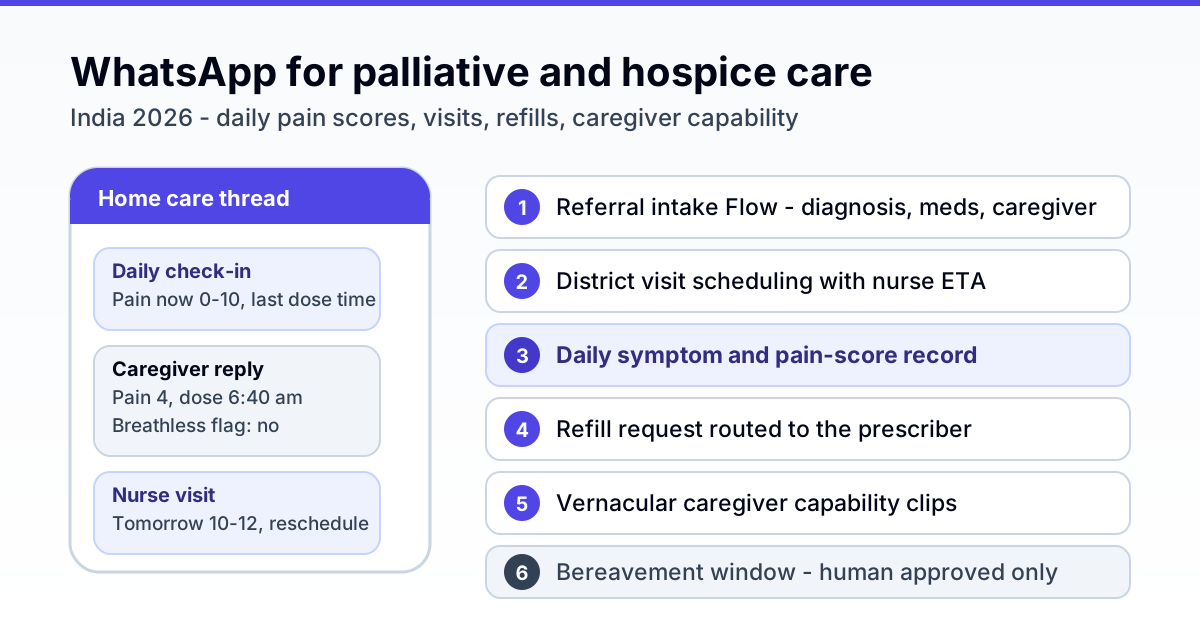
For an Indian palliative or hospice service, WhatsApp is the only channel that reliably reaches the person actually delivering the care: the family caregiver at home. Used properly it becomes a written daily record — pain score, last dose time, bowel and breathlessness flags, nurse-visit slot, refill request routed to the prescriber — across sixty to two hundred patients spread over a district, without adding a single phone line.
Everything below is about logistics and documentation. Automation in palliative care must never touch clinical judgement: no dose changes, no reassurance about a symptom, no narcotic authorisation. A human clinician reads every escalation. That boundary is not a disclaimer, it is the design constraint that makes the rest of the system safe to build.
The operational problem is unusual. Palliative care does not aim at cure; it aims at documented symptom control plus a caregiver who is genuinely capable at 2am. Studies of home-based care in India consistently attribute the overwhelming majority of care hours — commonly put at around 95 percent — to unpaid family members rather than clinicians; treat that as directional and verify against current literature. If the caregiver is the delivery mechanism, then the caregiver is also the data source, the training target and the escalation trigger. A small team cannot phone two hundred households daily. It can, however, read two hundred short structured submissions.
Why the daily written record is the whole product
Pain and distress in advanced disease move in trend lines, not events. A caregiver who says "she is not well" on a phone call gives you nothing comparable to last Tuesday. A caregiver who taps a 0-10 pain score, a last-dose timestamp and three yes or no flags gives you a curve. The curve is what lets a nurse escalate on day two instead of day nine — and what makes the service auditable, reportable to a funder, and defensible if a family later questions the care given.
Coverage is the context. Palliative care in India is widely cited as reaching only a low single-digit percentage of those who need it, with Kerala's community network the outlier — verify the current figure against NPPC reporting and the most recent Lancet Commission or IAPC data before quoting it. The practical read: most services are small, thinly staffed, partly volunteer-run, and expanding faster than their documentation.
| Symptom logging method | What actually gets recorded | Who can see the trend | Failure mode |
|---|---|---|---|
| Phone call to the office | Free text in a nurse's notebook, if she was free to answer | Only the nurse who took the call | Night calls go unanswered and unlogged; nothing is comparable week to week |
| Paper home-visit register | Detailed, but only on visit days | Whoever holds the file | Six blank days between visits; register stays in the patient's home or the nurse's bag |
| WhatsApp structured check-in | Pain score, last dose time, symptom flags, free-text note, timestamped | Whole team, on one dashboard, sorted by deterioration | Caregiver fatigue if the form is long or the reminders are noisy |
The regulatory frame, and the one rule that is unique to this field
Palliative care carries a compliance profile no other home-health vertical shares. Verify every point below against the current position for your state and your registration status; rules here move, and several are genuinely unsettled.
- NDPS Act and state Essential Narcotic Drugs rules. The 2014 NDPS amendment created the Essential Narcotic Drugs category specifically to simplify state-level licensing for oral morphine and similar medicines, but implementation still varies sharply between states, and the Recognised Medical Institution process is a state matter — verify your state's current RMI and stocking requirements. The operational consequence for messaging is absolute: a refill request may be acknowledged, logged and scheduled over WhatsApp, but dispensing is gated on a licensed physical institution and a prescriber. The bot must never appear to authorise a narcotic dose, confirm a quantity, or promise a collection time the pharmacy has not confirmed.
- DPDP Act 2023. Terminal-illness, pain and prognosis data is the most sensitive personal data your organisation will ever hold. Consent, purpose limitation and a defined retention period are the baseline. The genuinely open question is retention and access after death — who is the data principal once the patient has died, and on what basis does a bereaved relative see or delete the record. Treat that as unsettled and take legal advice; our CERT-In and DPDP breach-notification walkthrough covers the incident side of the same obligation.
- State Clinical Establishments Acts and NABH palliative or hospice standards. Applicability varies, and many Indian hospices operate as unregistered NGOs or as units inside a larger hospital — verify which registration regime you actually sit under before you design consent text or audit trails around it.
- National Programme for Palliative Care and NHM state palliative units. Directional only: state programmes and the widely-cited Kerala community-network model shape the funding and volunteer structures available to you. Verify current funding lines and district coverage locally.
- Telemedicine Practice Guidelines (2020, verify current status). These bound what a nurse or counsellor may do over a chat channel versus what requires a registered medical practitioner. Written asynchronous advice is not a neutral act — build escalation paths so anything resembling a clinical instruction comes from a person entitled to give it.
- GST and, for foreign-funded NGOs, FCRA. Brief mention, and verify: donation receipting and service-fee treatment differ, and FCRA-registered organisations carry separate reporting constraints.
Stage 1: Referral intake that does not vanish into a phone call
Referrals arrive from an oncologist, from a hospital discharge desk, or from the family directly, and in most small services they arrive as a phone call that one person half-remembers. Replace it with a structured intake Flow sent to the referrer or the primary caregiver: diagnosis and current line of treatment, current medicines with doses, mobility and dependency level, presence of a wound or catheter or stoma, the primary caregiver's own phone number and relationship, and language preference. Capture the caregiver's number as a first-class field, not as an afterthought — that number, not the patient's, is where the next six months of messaging goes.
Two intake fields matter more than they look. Consent: record it explicitly, in the caregiver's language, naming what you will send and how long you will keep it. And the language flag, which drives everything downstream — vernacular delivery is the difference between a training clip that gets watched and one that gets ignored, the pattern documented in vernacular and voice-first messaging for senior citizens.
Stage 2: Home-visit scheduling across a district
The home visit is the expensive resource. A nurse covering a district spends more of her day travelling than examining, so scheduling is a routing problem before it is a calendar problem. Cluster slots geographically, publish an ETA window rather than a time, and let families reschedule themselves. Self-serve reschedule is worth more than it sounds: the alternative is a missed visit, an hour of travel wasted, and a patient seen a week late.
Send a short pre-visit checklist the evening before — keep the current medicine strips out, note anything new since the last visit — and a post-visit summary the caregiver can show to a relative who was not present. The mechanics are close to what a home nursing and elder-care agency runs on WhatsApp, with one difference: in palliative care the visit often ends in a plan change, so the post-visit summary must be written by the clinician, not generated.
Stage 3: The daily symptom and pain-score check-in
This is the core of the system and it must take the caregiver under thirty seconds. A single WhatsApp Flow, sent at a fixed time the family chose: pain now on 0-10, pain at its worst today on 0-10, last dose time, and flags for constipation, appetite, breathlessness and confusion, plus one free-text box. Nothing else. Every extra field costs you completion rate, and a form completed on day forty is worth more than a thorough one abandoned on day four.
Book a WhatsApp clinic demo
See how clinics run appointment reminders, reports, and follow-ups on WhatsApp — DPDP-compliant, India-hosted. Book a 15-minute demo.
On the team side the value is the sort order. Submissions rank by change, not absolute score: a patient who moved from 3 to 7 outranks one steady at 6. Missing submissions rank too — two silent days from a household that answered daily for a month is itself a signal, and usually means the caregiver is overwhelmed rather than the patient comfortable. A nurse reviews that queue; the system only orders it.
Stage 4: Medication adherence and the refill request thread
Dose-time reminders go to the caregiver, phrased as prompts to record rather than instructions to act: "time for the 2pm dose — tap when given". Adherence data then arrives as a by-product of the reminder instead of requiring a separate question. For refills, ask for a photo of the current strip or bottle in the thread. It removes an entire class of error — wrong strength, wrong salt, a medicine the family stopped a fortnight ago — and it gives the prescriber something to look at before writing anything.
The narcotic line must be drawn in the product, not in staff training alone. A refill request for oral morphine or any Essential Narcotic Drug is captured, timestamped and routed to the prescriber. It is never auto-approved, never given a quantity by the bot, and never confirmed as collectable until a licensed institution has confirmed stock. The bot does not change doses and does not comment on whether a dose is working. Say it plainly in the thread so the family is never in doubt about what they are talking to.
| Lifecycle stage | Automation may | Automation must not | Human step |
|---|---|---|---|
| Referral intake | Collect structured history, consent, caregiver contact, language | Accept or triage the referral, or state a prognosis | Clinician reviews and accepts onto the caseload |
| Visit scheduling | Offer slots, send ETA, take reschedules, send reminders | Decide visit frequency or clinical urgency | Nurse in charge sets frequency |
| Daily check-in | Ask fixed questions, record answers, rank the review queue | Interpret a score, reassure, or say a symptom is normal | Nurse reads the queue and calls where needed |
| Medication and refills | Remind, log administration, capture a strip photo, route the request | Approve a narcotic refill, state a quantity, alter a dose | Prescriber writes; licensed institution dispenses |
| Caregiver training | Deliver the right vernacular clip at the right point in the illness | Substitute for a hands-on demonstration on a first visit | Nurse demonstrates, then the clip reinforces |
| Bereavement | Hold a scheduled follow-up window and suppress all other messaging | Send anything unreviewed, or any marketing or fundraising template | Named staff member approves each message |
Stage 5: Caregiver capability, not caregiver information
The deliverable here is capability. A relative who has watched a ninety-second vernacular clip on two-hourly repositioning, done it once with a nurse watching, and can find the clip again at midnight is a different caregiver from one who was handed a printed leaflet on discharge day. Build a small library and release it by stage rather than all at once: repositioning and pressure-area care, mouth care when the patient stops drinking, safe transfers, syringe-driver and subcutaneous-line basics where used, constipation management, and the single most valuable clip of all — what "this is expected" looks like versus what "call us now" looks like.
Pair that with an unambiguous escalation instruction. Families hesitate at night because they do not want to trouble anyone, so the threshold has to be written down and repeated: these signs, this number, at any hour. If your service uses a private ambulance partner, the handover script belongs in the same thread — see WhatsApp for private ambulance and EMS dispatch. For families navigating scheme cover alongside terminal illness, Ayushman Bharat PM-JAY card queries over WhatsApp saves your counsellor a repeated conversation.
Stage 6: Bereavement follow-up, volunteers and donors
The moment a patient dies, the messaging system must change behaviour immediately, and this is where most implementations fail. On death confirmation: stop every scheduled reminder, check-in and campaign on that thread the same day; move the contact to a bereavement state that no broadcast, no fundraising appeal and no marketing template can reach; and open a human-approved follow-up window — typically a condolence message, then a check at a few weeks and again near the first anniversary, each written or at minimum approved by a named person. Automation here schedules the reminder to a staff member. It does not write the message.
Two safeguards are worth hard-coding. Keep bereaved contacts in a separate audience that campaign tooling cannot select. And decide, in writing, how long you retain the clinical thread after death and who may access it — the DPDP question flagged earlier is not academic once a relative asks for the record.
The funding side runs on the same channel. Volunteer rostering — shift offers, confirmations, visit reports — and donor receipting with an 80G acknowledgement are both straightforward utility messaging, with the same discipline: donors and volunteers are separate audiences from patients and bereaved families, and those lists must not be able to touch each other.
Templates, costs and what to build first
Anything your system initiates outside an open twenty-four-hour customer-service window needs a pre-approved template. Anything you send inside that window, because the caregiver messaged first, is a free-form session message. In palliative work the practical effect is that daily check-in prompts, dose reminders and visit reminders are utility templates, while the substantial conversation that follows a caregiver's reply happens inside the session window.
The conversation window cost calculator is the quickest way to see what the window rules do to your monthly bill.
| Message | Template or session | Notes |
|---|---|---|
| Daily check-in prompt | Utility template | Fixed time chosen by the family; one per day, no chasers |
| Caregiver reply and the nurse conversation after it | Session window | Free-form for twenty-four hours from the caregiver's message |
| Dose-time reminder | Utility template | Record-keeping phrasing, never instruction phrasing |
| Visit slot, ETA and reschedule confirmation | Utility template | Transactional; highest-value template in the set |
| Refill request acknowledgement | Utility template | Acknowledges receipt and routing only; no approval, no quantity |
| Caregiver training clip | Session where possible | Send after a caregiver question so it lands in an open window |
| Bereavement follow-up | Utility template, human-approved | Separate audience; no marketing template may ever reach it |
| Donor receipt and volunteer roster | Utility template | Distinct audiences from patient and bereaved lists |
RichAutomate is priced usage-only: ₹0 setup and ₹0 monthly platform fee. On Client Pay it is ₹0.10 per message. On SaaS Pay it is ₹1.50 for marketing and ₹0.50 for utility. For a service running a daily check-in plus dose and visit reminders across a caseload of a hundred or so patients, almost all traffic is utility and session, which is the cheap end of that structure.
One thing no platform can promise, and we will not: there is no guarantee against restriction or blocking for unsolicited or bulk sending. Palliative messaging is the opposite of bulk — every thread is a consented, individually enrolled household — and that is why it is durable. Keep it that way.
Sequence matters when the team is three nurses and a coordinator. Build the intake Flow first, because it fixes the caregiver phone number and consent everything else depends on. Build the daily check-in second and run it on twenty households for a month before scaling. Add visit scheduling third, once the check-in queue shows where visits are actually needed. Refills, the training library and bereavement handling follow, in that order. Reporting then comes free, because the daily record already exists — and a service that can show a funder a symptom-control trend across two hundred patients is in a different conversation than one showing visit counts.
The commercial argument is narrow and honest: documented care is better care, and it is also fundable care. Nothing here replaces clinical judgement. The system handles logistics and documentation only, a human clinician reads every escalation, and the last mile is still a nurse on a district road.