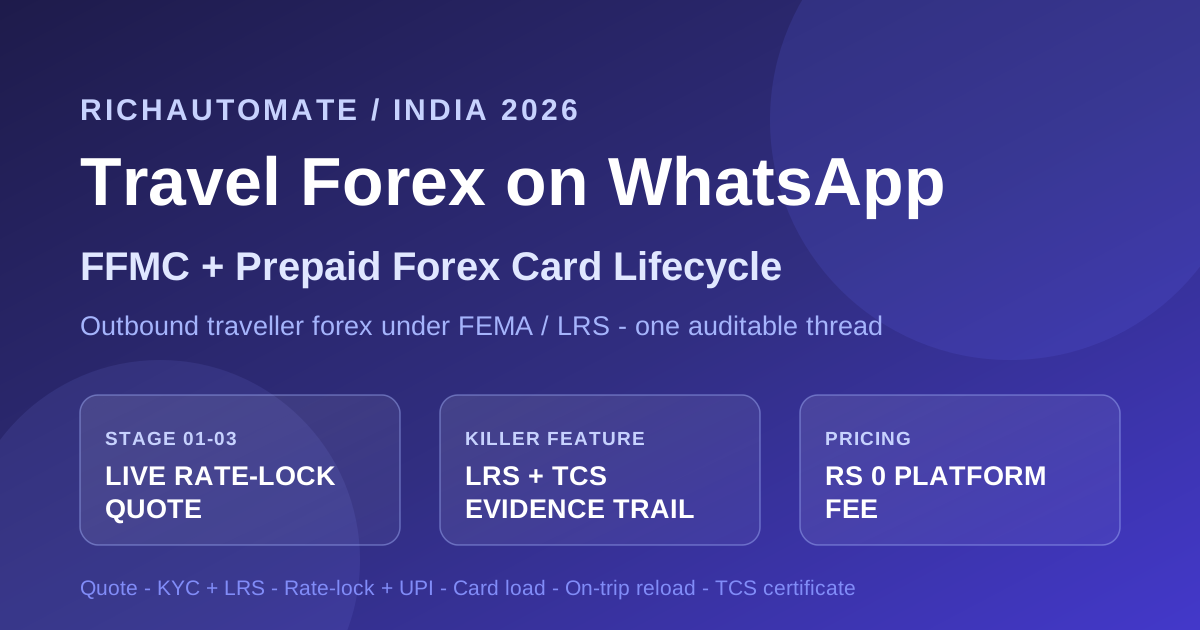
If you run an authorised money-changer business in India — an FFMC or an AD-II licence-holder selling foreign currency and prepaid forex cards to outbound travellers — your hardest problem is not the FX spread. It is the evidence. A customer flying to London next week wants a live rate now, locks it, pays, loads a card, and three weeks later disputes the rate he was charged, or asks for his TCS certificate at tax time, or claims he never saw the LRS declaration he signed. Meanwhile every quote, locked rate, KYC document, Liberalised Remittance Scheme declaration and TCS deduction lives in a different place — a phone call, a counter slip, a spreadsheet, an email — and when an auditor, a customer or a bank asks you to reconstruct one transaction, you cannot. WhatsApp, run as a structured outbound-traveller forex layer rather than a chat line, becomes the single thread that carries the live rate quote, the rate-lock, the KYC and LRS declaration, the UPI payment, the card-load confirmation and the TCS certificate — all timestamped against one customer and one trip. The killer asset is the rate-lock plus LRS/TCS evidence trail: every quote, locked rate, LRS declaration and TCS deduction logged in one thread, so the traveller has proof and you have an audit trail for FEMA/LRS compliance. This guide is the money-changer's operations playbook. Every figure here is illustrative and directional, and every RBI, FEMA, LRS and TCS specific must be verified against current official sources as of 2026. This is general information, not financial or tax advice.
Why outbound traveller forex breaks at quote, lock and proof
A money-changer rarely loses on the currency itself. It loses at the seams. A walk-in or a phone enquiry asks "what's your rate for euros today?" — the rate moves while he decides, he books elsewhere, and you have no record of the quote you gave. He pays, you load a prepaid card, and weeks later he disputes the rate, the markup or the fees, with nothing but his memory against yours. At tax time he asks for the TCS certificate for the tax collected at source on his foreign-exchange purchase, and you are digging through counter slips to assemble it. An auditor or your AD-bank asks you to show, for a single LRS transaction, the customer declaration, the purpose code and the KYC on file — and they are in four different systems. The FX transaction is usually fine. The evidence trail around it — the quote, the locked rate, the declaration, the tax — is where disputes, compliance gaps and customer trust leak. A structured WhatsApp thread closes exactly that gap: it stamps every quote and lock, attaches the KYC and LRS declaration, records the UPI payment and the card-load, and files the TCS certificate, all against one trip.
If you are unsure where you stand, the WhatsApp compliance self-audit covers the checks in order.
Why WhatsApp fits the money-changer and the traveller
The outbound-traveller journey spans a customer who is busy, anxious about a trip and rate-sensitive, and a money-changer who must stay inside a tight regulatory box. The traveller already has WhatsApp open all day; he will not install a forex app for one trip a year, but he will tap a button to get a live rate, upload his passport and PAN, and lock a rate in a thread. The money-changer needs to push a live quote fast, collect KYC and the LRS declaration cleanly, take payment, confirm the card-load and issue the TCS certificate — and keep every step auditable. WhatsApp carries images and PDFs natively (passport, visa, ticket, PAN, the signed declaration, the TCS certificate), supports structured Flows for KYC and declarations inside the chat, threads the whole trip in one place, and reaches the traveller wherever he is — including mid-trip, abroad, when he needs a reload or hits a fraud alert. You are not asking the customer to adopt new software; you are routing the proof the transaction already generates into one thread tied to his trip. To keep these traveller relationships, repeat-trip history and follow-ups organised on top of the forex layer, an operator can pair it with the best WhatsApp CRM for India on the same number. The KYC and declaration discipline mirrors what regulated lenders already run — see our WhatsApp for BFSI and fintech KYC guide for the broader pattern.
The six-stage outbound-forex lifecycle on WhatsApp
Map the traveller's forex journey as six handovers, each a WhatsApp checkpoint that captures evidence before the next stage proceeds. The discipline is simple: nothing advances until this stage's proof is in the thread, filed against the customer and the trip.
| Stage | What happens on WhatsApp | Evidence captured |
|---|---|---|
| 1. Trip enquiry + live rate quote | Traveller asks for a currency and amount; a human-confirmed live rate is quoted with a clear validity window | Quote, currency, rate, timestamp, validity |
| 2. KYC + LRS declaration (Flow) | Traveller completes KYC (passport, PAN, visa/ticket) and the LRS declaration inside a WhatsApp Flow | KYC documents, signed LRS declaration, purpose |
| 3. Rate-lock + UPI payment | Traveller locks the quoted rate within the window and pays; the locked rate is recorded | Locked rate, lock time, UPI payment reference |
| 4. Card-load confirmation + usage tips | The prepaid forex card is loaded; confirmation and safe-usage tips are sent | Load amount, card reference, TCS line, confirmation |
| 5. On-trip reload + fraud-alert thread | Mid-trip top-up requests and any fraud/usage alerts route through the same thread | Reload requests, alert acknowledgements, locked rates |
| 6. Post-trip refund/encash + TCS certificate | Unused balance is encashed/refunded per rules; the TCS certificate is issued in-thread | Encash record, refund reference, TCS certificate |
The trip is the spine — every quote, lock, declaration, payment and certificate downstream is filed against the customer and that trip, so a full transaction can be reconstructed in seconds when a customer, an auditor or your AD-bank asks. This is the operating model; every regulatory name attached to stages 2, 4 and 6 — FEMA, LRS, the TCS provisions under Section 206C(1G) of the Income-tax Act — must be verified as of 2026.
The rate-lock plus LRS/TCS evidence trail — the real differentiator
Everything above exists to produce one asset: a complete, time-ordered evidence trail tied to one trip. This is what separates a WhatsApp-run forex desk from a WhatsApp-chatty one, and it does two jobs at once. It gives the traveller proof. When a customer disputes the rate, the markup, the fees or the tax weeks later, you forward that trip's record: here is the quote at this time, here is the rate he locked within the validity window, here is the UPI payment, here is the card-load with the TCS line, here is his signed LRS declaration. A dispute that used to be his memory against yours — and often ended in a goodwill refund — collapses into one message. It gives you a compliance audit trail. The same thread that reassured the customer also assembles, for FEMA and LRS purposes, the customer KYC, the purpose of the remittance, the declaration that the transaction is within the applicable LRS limit (verify the current cap and rules as of 2026), and the TCS deducted with its certificate. When an auditor or your authorised-dealer bank reviews a transaction, you produce the bundle from one place. The evidence is the same whether the questioner is a customer defending a rate or a regulator checking a declaration; you build it once, as a by-product of running the trip on WhatsApp.
The evidence-trail rule: no stage advances without its proof in the thread, and every quote, lock, declaration, payment and certificate is filed against the customer and the trip — not just the contact, not just the date, the customer and the trip. If you cannot pull a single transaction's full record — quote, locked rate, KYC, LRS declaration, payment, card-load and TCS certificate — in under a minute, you do not have an audit trail; you have a chat history. Build the customer-and-trip key first; everything else hangs off it. And remember the rate-lock is a commercial validity window your desk honours, confirmed by a person — never marketed as a "guaranteed best rate".
WhatsApp vs phone or branch visit for outbound forex
Most money-changers today run on a mix of phone enquiries, walk-in counter visits and email for documents. Here is why a structured WhatsApp layer outperforms each for the quote-lock-and-proof job specifically.
| Need | Phone enquiry | Branch / counter visit | Structured WhatsApp |
|---|---|---|---|
| Live rate quote with a record | Spoken, no record; rate moves before decision | Counter slip, customer must travel in | Quoted in-thread with timestamp and validity |
| KYC and LRS declaration | Emailed back and forth, scattered | Paper at the counter, manual filing | Completed in a Flow, attached to the trip |
| Rate-lock | Verbal "I'll hold it" — disputable | Held only if he is standing there | Locked within the window, time-stamped |
| Payment | Separate call or visit | In person | UPI in-thread, reference recorded |
| On-trip reload / fraud alert | International call, costly, no record | Impossible once he has flown | Same thread, abroad, on any data |
| TCS certificate and dispute retrieval | Hunt across calls and slips | Re-visit the branch | Forward the trip record in seconds |
WhatsApp does not execute the FX transaction, hold your foreign-currency stock, or replace your back-office and AD-bank reporting system — and it is not your system of record for regulated facts. A person on your desk confirms the live rate before it is honoured, verifies KYC, and signs off the LRS and TCS specifics. WhatsApp is the customer-facing surface that pulls the right proof into one thread at the right moment, on the device the traveller already carries, without anyone chasing documents over email.
Get the India 2026 WhatsApp BSP price comparison
Wati vs AiSensy vs Interakt vs RichAutomate: Meta rates, platform fees and hidden costs, side by side. We send it to your WhatsApp in a minute.
Distinct from inbound remittance — this is outbound traveller forex
Be clear about what this playbook is and is not, because we have written adjacent BFSI pieces that look similar but solve the opposite problem. This is outbound traveller forex under FEMA and the Liberalised Remittance Scheme — a resident Indian buying foreign currency or loading a prepaid forex card to travel abroad, with TCS collected at source on the purchase. It is not inbound remittance — money flowing into India. Our WhatsApp NRI remittance guide and our blue-collar GCC-migrant remittance guide both cover the inbound direction: an NRI or an overseas worker sending money home to family in India. The regulatory frame, the direction of funds, the documentation and the tax treatment all differ. Inbound = foreign money coming to India (NRI/migrant remittance). Outbound = you, a resident, buying foreign currency to travel, governed by LRS, with TCS deducted (this piece). If you sell both, run them as two separate threads with two separate evidence trails — do not conflate the purpose codes, the declarations or the tax lines.
Per-stage automation, KPI and compliance guardrail
Automation should serve the evidence trail and the KPI, never run ahead of a human signoff on a regulated fact such as the live rate, the KYC outcome or the LRS/TCS treatment. Map each stage to the metric it moves and the guardrail it must respect.
| Stage | Automation | KPI moved | Compliance guardrail |
|---|---|---|---|
| Enquiry + quote | Push a live rate with a clear validity window | Quote-to-lock conversion % | Rate human-confirmed; never "guaranteed best rate" |
| KYC + LRS declaration | Run KYC and the declaration in a Flow | KYC completion % | PMLA/KYC and LRS declaration verified by a person (2026) |
| Rate-lock + UPI pay | Lock within the window; capture the payment ref | Payment-completion % | Lock is a commercial window, not a guarantee |
| Card-load + tips | Confirm load; send safe-usage and TCS line | Load-confirmation % | TCS slab illustrative — verify Section 206C(1G) as of 2026 |
| On-trip reload + alert | Re-quote and re-lock for top-ups; route alerts | Reload response time | Fraud facts only; human owns any block/refund |
| Refund/encash + TCS cert | Issue the TCS certificate and encash record | Certificate-issued % | Encashment and tax per current rules — human-confirmed |
Compliance, KYC and tax — the guardrails that matter
An outbound forex desk sits inside one of India's tighter regulatory boxes, and the thread must respect it. You operate under your RBI authorisation as a money-changer — an FFMC, or an AD Category-II, with its permitted activities (verify your category's exact scope and any renewal or reporting conditions as of 2026). Customer onboarding must meet PMLA and KYC obligations — identity, the purpose of the foreign-exchange purchase, and the records you must retain (verify the current KYC and record-retention requirements). The transaction must sit within the Liberalised Remittance Scheme — the customer's declaration that the purchase is within the applicable LRS limit for the financial year and for a permitted purpose (the LRS cap and permitted-purpose list are illustrative here and must be verified against current FEMA/RBI rules as of 2026; do not rely on any number stated from memory). Tax collected at source applies on foreign-exchange purchases under Section 206C(1G) of the Income-tax Act, with thresholds and rates that differ by purpose and amount — every TCS slab, threshold and the certificate format is illustrative, verify current rate as of 2026; do not quote a percentage or a limit without checking. The discipline that makes the evidence trail work is the same discipline these rules reward: collect only what KYC and the declaration genuinely need, retain only as long as the law requires, treat your messaging platform as a processor whose terms you have checked, and keep a human in the loop for every rate, declaration and tax line. WhatsApp stores the proof; your desk and your AD-bank reporting remain the system of record. This is general information, not financial or tax advice; verify every specific against the current RBI, FEMA and Income-tax sources as of 2026.
The trust-and-audit flywheel: the same threads that captured a season of clean quotes, locked rates, declarations and TCS certificates are your strongest asset on two fronts at once. With travellers, a desk that can instantly produce the locked rate and the TCS certificate wins disputes it used to refund — fewer goodwill credits, fewer charge-backs, and a repeat-trip customer who comes back next holiday because his last forex experience was clean and documented. With regulators and your AD-bank, a transaction trail that is evidence rather than scattered slips makes audits faster and lighter, and lowers the risk of a compliance gap turning into a finding. Reliable evidence lowers your customer-dispute losses and your audit risk together. Close every trip with the refund/encash and TCS-certificate step, and over a few travel seasons the evidence trail compounds into a forex operation that is cheaper to run, easier to audit, and harder for anyone to dispute. Cohort and conversion figures here are illustrative and directional, not promises.
A 30-day rollout runbook
Days 1–7 — design the spine. Define your customer-and-trip key and the six-stage gate map; with your compliance desk and AD-bank, list the exact KYC, LRS-declaration and record-retention obligations and the TCS treatment you must apply today (verify your RBI authorisation scope, the LRS limit and Section 206C(1G) slabs as of 2026). Days 8–14 — wire the quote and KYC. Stand up the live-rate quote with a human-confirmed validity window, and the KYC-plus-LRS-declaration Flow tied to the trip. Days 15–21 — wire lock, pay and load. Add the rate-lock within the window, the UPI payment capture, and the card-load confirmation with its TCS line and safe-usage tips. Days 22–27 — wire on-trip and post-trip. Turn on the reload-and-fraud-alert thread and the refund/encash plus TCS-certificate step; pilot on one branch and one currency pair. Days 28–30 — review and harden. Pull a random transaction and try to reconstruct its full record — quote, locked rate, KYC, LRS declaration, payment, card-load and TCS certificate — in under a minute; fix any gap, assign an owner, and confirm a human signs off every rate, declaration and tax line. Timelines and all figures here are illustrative and directional — adapt to your branch network and currency mix, and verify every RBI, FEMA, LRS and TCS specific as of 2026. To take payments cleanly inside the thread, see our WhatsApp native UPI checkout builder guide, and see full pricing to size the per-message cost against your transaction volume.
This article is general information, not financial, tax, legal or compliance advice. India's foreign-exchange framework — RBI money-changer (FFMC/AD-II) authorisation, FEMA, the Liberalised Remittance Scheme and its limits and permitted purposes, PMLA/KYC obligations, and tax collected at source under Section 206C(1G) of the Income-tax Act — changes, and limits, slabs, thresholds, rates, purpose codes and retention periods are revised regularly. The LRS cap and the TCS slabs referenced here are illustrative and must be verified against current official sources; do not rely on any number stated from memory. Numbers, cohort figures and sizing here are illustrative and directional. WhatsApp does not execute the FX transaction and is not your system of record for regulated facts — a person confirms rates, KYC, declarations and tax. Verify every specific against the current RBI, FEMA and Income-tax sources as of 2026 and consult qualified advisors before relying on any point here.
Run your outbound forex desk on WhatsApp
RichAutomate gives money-changers the official Meta WhatsApp Business API with a no-code flow builder, in-chat KYC and LRS-declaration Flows, document and PDF capture (passport, visa, ticket, PAN, declaration, TCS certificate), UPI payment links, trip-based threads, rate-lock messaging, reload and fraud-alert routing and a shared team inbox — so your live quotes, locked rates, declarations, payments, card-loads and TCS certificates live in one evidence trail per trip, settling customer disputes and FEMA/LRS audits alike. ₹0 platform fee, ₹0 setup, ₹0 monthly — pay per message only: Client Pay ₹0.10/msg with Meta's conversation charges billed to you directly by Meta, or SaaS Pay ₹1.50 marketing / ₹0.50 utility-auth. 14-day free trial with 100 credits. See full pricing, WhatsApp us at 918160311319, or book a 30-minute walkthrough at https://richautomate.in/book/demo.