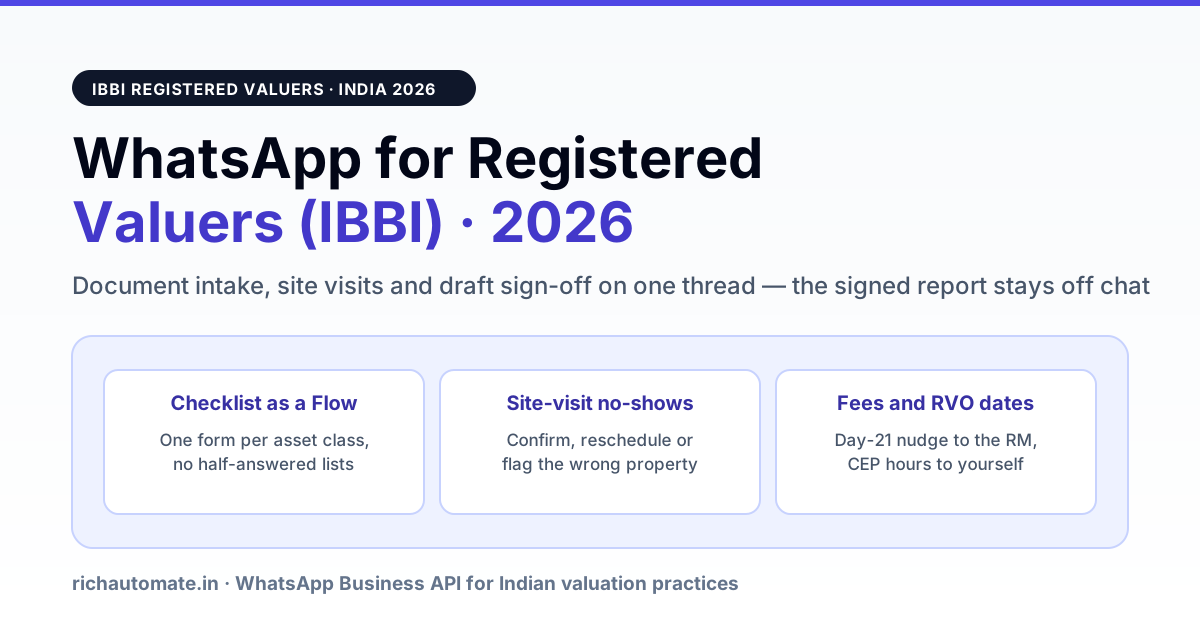
A registered valuer in India can run the entire client-facing side of a valuation practice — engagement intake, the document checklist, site-visit scheduling, draft-report sign-off and fee follow-up — on WhatsApp Business API, and most IBBI-registered valuers should, because that is where their bank-panel relationship managers and promoter clients already reply. What you cannot do on WhatsApp is deliver the valuation opinion itself: the Companies (Registered Valuers and Valuation) Rules, 2017 require a signed report issued under your registration number, so WhatsApp handles the workflow around the report, never the report.
Who this is for: the IBBI registered valuer, not the insolvency professional
The two registrations get confused constantly, including by bank staff. A Registered Valuer (RV) is registered with the Insolvency and Bankruptcy Board of India (IBBI) as the authority notified under Section 247 of the Companies Act, 2013, read with the Companies (Registered Valuers and Valuation) Rules, 2017. An Insolvency Professional (IP) is a separate registration under the IBC that runs resolution processes. An IP frequently appoints two registered valuers; the two roles are not interchangeable and the workflows barely overlap. If you run resolution mandates rather than valuations, the sibling guide on WhatsApp for insolvency professionals is the one you want.
Registration is by asset class, and the asset class dictates almost everything about your client mix:
- Land & Building (L&B) — heaviest volume, mostly bank panel work: mortgage valuations, SARFAESI sale-notice reserve prices, and one-time-settlement assessments. High job count, low ticket, brutal turnaround expectations.
- Plant & Machinery (P&M) — industrial units, lender consortium reports, liquidation estimates. Fewer jobs, heavier site work, long document lists.
- Securities or Financial Assets (S&FA) — share valuations for Section 62(1)(c) preferential allotments, FEMA pricing certificates for inbound investment, ESOP valuations, and merger swap ratios. Low volume, high ticket, almost entirely document-driven with no site visit.
Where the turnaround actually goes
Across a typical Land & Building panel practice, the valuation analysis is rarely the bottleneck. The sequence that eats the calendar looks like this:
- A bank relationship manager forwards a case on WhatsApp with a blurry photo of a sanction note. No address pin, no owner phone number.
- You call the borrower. They do not pick up. You call again next morning.
- You ask for the sale deed, the approved plan, the latest property-tax receipt and the mutation extract. Three arrive; the approved plan does not.
- The site visit is fixed for Thursday. Nobody is at the property on Thursday.
- The draft goes out by email. The relationship manager reads it eleven days later and asks one question that could have been asked on day one.
- The invoice sits unpaid for six weeks because it went to a shared branch mailbox.
Steps 1, 3, 4 and 6 are pure coordination. They are also the four steps where WhatsApp beats email and phone outright, because the borrower and the relationship manager are both already reading WhatsApp and neither is reliably reading email.
The document checklist as a WhatsApp Flow, per asset class
The single highest-return automation for a valuation practice is a structured document-collection Flow keyed to asset class. Instead of typing the same list into every chat, a Flow presents the borrower a form: property type, address with a location pin, a contact number for site access, and file-upload slots for each required document. It refuses to submit until the mandatory slots are filled, which is the entire point — an email checklist can be half-answered, a Flow cannot.
Checklists worth encoding:
- Land & Building: sale deed or title document, approved building plan, latest property-tax receipt, electricity bill, encumbrance certificate, mutation or khata extract, occupancy certificate where applicable, and a contact number for whoever will open the gate.
- Plant & Machinery: fixed-asset register, purchase invoices with commissioning dates, import bills of entry for imported machines, AMC and breakdown history, and the plant layout.
- Securities or Financial Assets: last three audited financials, provisional current-year numbers, shareholding pattern, cap table with any convertible instruments, the board resolution, and the specific statutory purpose — Section 62(1)(c), FEMA pricing, ESOP, or a scheme of arrangement. Purpose drives method, so it must be captured at intake, not guessed later.
Two design choices matter here. First, keep one Flow per asset class rather than one giant branching form — valuers who try to serve all three registrations from a single Flow end up with a form nobody completes. Second, send the Flow from a template message the first time you contact the borrower, because you are opening the conversation and Meta will bill it as business-initiated regardless.
Site visits: confirm, reschedule, and the no-show problem
A wasted site visit is the most expensive event in a Land & Building practice — half a day of a valuer's time plus travel, unbillable. A three-message pattern cuts no-shows sharply:
Get a 1-minute BSP audit on WhatsApp
Drop your WhatsApp number — we line-item your current invoice against Meta India rates in under 60 seconds. India-hosted, DPDP-compliant.
- T-24h: a utility template naming the date, the two-hour window and the exact address, with quick-reply buttons — Confirm, Reschedule, Wrong property.
- Reschedule tapped: the bot offers the next three available slots from the valuer's calendar rather than starting a phone-tag loop.
- T-2h: the site engineer shares live location and an ETA inside the open session window, which by then is free because the borrower replied to the confirm.
The Wrong property button matters more than it looks. Bank panel cases routinely carry the wrong survey number from the sanction note, and catching that the day before is the difference between a phone call and a lost day.
Draft review, sign-off, and the compliance line you do not cross
Use WhatsApp to move the draft, never to be the draft. The safe pattern: the draft PDF goes out as a document message, review reminders go out as templates at T+3 and T+7 days, and the client's comments come back in chat. The final report is then signed with your IBBI registration number and issued through your normal channel.
Three lines a registered valuer should not cross on chat:
- No indicative value before the report. A number typed into WhatsApp ahead of the signed report is exactly the pressure point the IBBI model code of conduct for registered valuers targets — independence, and the absence of a predetermined value, are what that code is about.
- No unsigned report doing the job of a signed one. A draft shared for comment must be watermarked as a draft. Lenders will use whatever is in their inbox.
- No cross-client detail in a group. Bank relationship managers create WhatsApp groups per branch and drop unrelated borrowers into them. Run client work in one-to-one conversations from the business number instead, which is also the only way you get a clean per-case audit trail.
DPDP obligations a valuation practice picks up by default
Valuation intake collects a heavy bundle: title documents, tax receipts, identity proofs, and in Securities & Financial Assets work the complete cap table and financials of a private company. Under the Digital Personal Data Protection Act, 2023 you are a data fiduciary for the borrower's personal data even when the bank sent you the case.
The workable minimum: state the purpose on the Flow's first screen at intake, retain documents for the period your engagement letter and record-keeping obligations actually require rather than forever, keep media off personal devices by using the platform's stored media rather than device downloads, and have a deletion path you can run when a client asks. The broader mechanics are in the DPDP Act 2023 WhatsApp compliance checklist.
Fee follow-up without nagging
Bank panel fees are small and slow, and chasing them by email is where most write-offs happen. A two-step utility template — invoice at delivery, one reminder at day 21 addressed to the named relationship manager rather than a branch mailbox — recovers more than a dozen phone calls do, because it lands somewhere a person actually reads. Private-client work settles faster still when a payment link rides in the same message; bank panel payments will always route through the branch's own process. Practices that already run this pattern in adjacent lending workflows are described in the guide for loan DSAs and mortgage brokers.
Compliance reminders worth automating for yourself
Registered-valuer status carries recurring obligations, and they are easy to encode as scheduled reminders on the same number you use for clients: Registered Valuer Organisation membership renewal, continuing-education hours before the RVO's cut-off, the annual compliance filings your RVO prescribes, and professional indemnity renewal. Missing an RVO deadline is self-inflicted and avoidable, and it is exactly what a calendar-triggered template solves.
What it costs
WhatsApp Business API pricing in India is charged per conversation, not per message, and Meta has been moving both the categories and the rates. A solo Land & Building valuer running perhaps 40 cases a month sends roughly three to five business-initiated conversations per case — intake, site-visit confirm, draft reminder, invoice — which lands in the low hundreds of rupees monthly. A five-valuer practice at 200 cases sits closer to ₹900. Service conversations inside the 24-hour window opened by the client's reply are free, which is why the confirm-button pattern above is cheap to run.
The variable that actually decides your bill is the platform fee on top. Several Indian BSPs charge a per-seat monthly fee that dwarfs the Meta charges at this volume. Compare the all-in number, not the headline rate — the arithmetic is laid out in the WhatsApp Business API cost breakdown for India.
A realistic 30-day rollout
- Week 1 — get the business number verified and pick the display name carefully: use the firm name on your IBBI registration, not a trade nickname, or display-name review will bounce it. Build the intake Flow for your highest-volume asset class only.
- Week 2 — submit three templates for approval: intake invitation, site-visit confirm with buttons, invoice-with-reminder. Approval takes hours to a day; build the rest while you wait.
- Week 3 — run it on live cases from one bank panel. Watch where borrowers drop out of the Flow; that screen is asking for something they do not have.
- Week 4 — add the second asset class, wire the RVO compliance reminders to yourself, and switch on the fee-follow-up sequence.