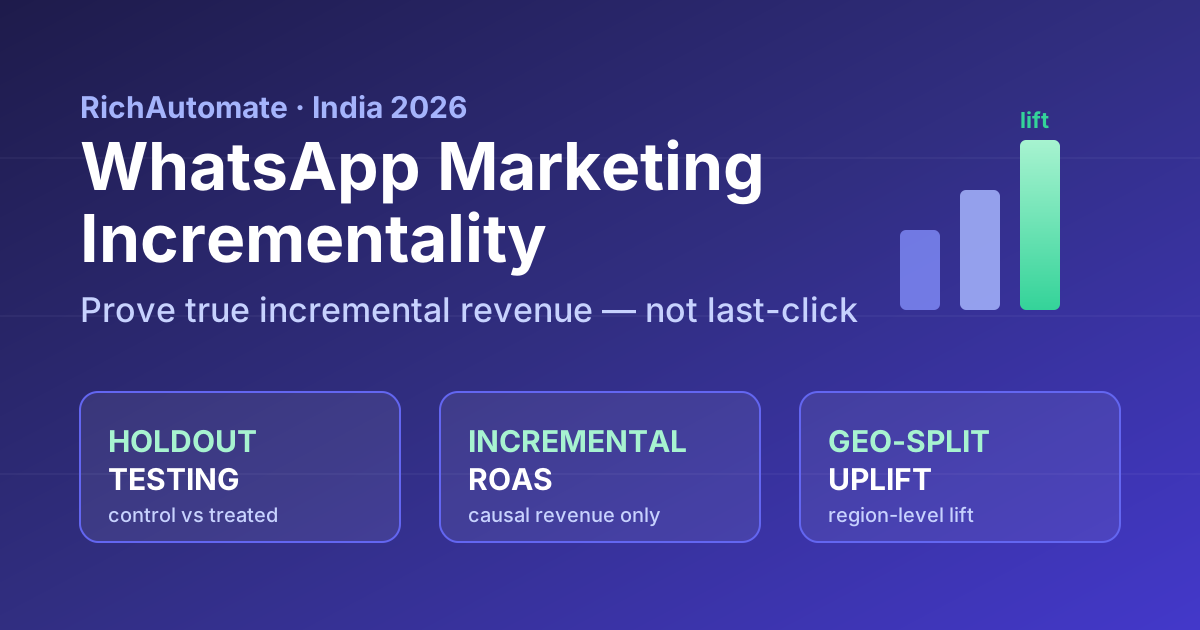
Open almost any Indian growth team's WhatsApp dashboard and the numbers look spectacular: abandoned-cart nudges "recovering" lakhs in revenue, reorder reminders posting eye-watering ROAS, win-back blasts credited with sales the last-click report attributes entirely to the message. The uncomfortable question a sharp CMO eventually asks is: how much of that revenue would have happened anyway? Last-click attribution cannot answer it, because last-click does not measure cause — it measures which touch happened to be last. WhatsApp is especially good at being the last touch, because it lands on a channel people actually open and it often fires at customers who were already going to buy. That makes it a brilliant intent-harvester and a terrible thing to judge by last-click alone. This guide is about proving the incremental revenue WhatsApp marketing genuinely creates — the sales that would not have happened without the message — using holdout groups, geo-split tests, ghost-ad-style controls and uplift modelling, the way performance-marketing science actually works. It is practical: a growth team should be able to run its first WhatsApp holdout after reading. Every market, regulatory (DPDP) and Meta-platform specific is directional and must be verified against official sources as of 2026; all cohort, uplift and ROAS numbers are illustrative. This is general information, not legal, financial or statistical-consulting advice.
Why last-click over-credits WhatsApp marketing
Last-click attribution assigns 100% of a conversion to the final marketing touch before purchase. It is simple, it is built into most dashboards, and for a channel like WhatsApp it is systematically misleading. The reason is selection: the customers you message are not a random slice of humanity — they are your existing buyers, cart-abandoners and recent browsers, i.e. the people most likely to convert anyway. When a reorder reminder lands on a customer who reorders every month like clockwork, last-click hands the reminder full credit for a sale that was already coming. The message harvested existing intent; it did not create it. This is why WhatsApp campaigns so often post numbers that look too good to be true — because, as a measure of incremental impact, they frequently are. The fix is not to distrust the channel (WhatsApp genuinely drives real incremental revenue) but to distrust last-click as the way you size it. The only honest way to separate "revenue the message caused" from "revenue that would have happened anyway" is to compare a group that got the message against a comparable group that did not. That comparison — the holdout — is the foundation everything else in this guide builds on. For the broader metric framework WhatsApp marketing sits inside, our guide to WhatsApp campaign KPIs and metrics for India covers the dashboards last-click populates; incrementality is the discipline that keeps those dashboards honest.
Attribution vs incrementality — two readings of the same campaign
The cleanest way to feel the gap is to read one campaign two ways. Imagine an abandoned-cart WhatsApp template sent to 10,000 customers. The last-click dashboard reports every recovered cart as a win. An incrementality test — where a randomly held-out slice got no message — reveals how many of those customers would have returned and purchased regardless. The directional, illustrative table below shows the same campaign under both lenses; the numbers are made up to make the logic vivid, not to quote a benchmark — measure your own.
| Reading of the same campaign | What it counts | Illustrative result (directional) |
|---|---|---|
| Last-click attribution | Every conversion after the message = caused by the message | 900 conversions credited, "₹18L recovered", ROAS looks huge |
| Holdout-measured incrementality | Messaged-group rate minus control-group rate = the lift | Control would have converted at, say, 6%; messaged at 9% → only the 3pp gap is incremental |
| The honest number | Incremental conversions = (lift %) × audience | ~300 truly incremental conversions, not 900 — a third of the headline |
Read top to bottom and the lesson lands: last-click reported 900, incrementality found ~300, and the other ~600 were customers who would have come back on their own. Neither number is "wrong" — they answer different questions. Last-click answers "what was the last touch?"; incrementality answers "what did the campaign cause?" Only the second number tells you whether to scale the campaign, because only the second is the revenue you would lose if you switched it off. Notice too that incrementality does not make WhatsApp look bad — a genuine 3-point lift on 10,000 customers is real money the channel created. It just right-sizes the claim, which is what lets you make good budget decisions instead of flattering ones. If your debate is specifically about how WhatsApp interacts with paid acquisition, our guide to WhatsApp, Google and Meta ads attribution in India covers the multi-touch picture that incrementality testing ultimately corrects for.
The four ways to measure incrementality
There is no single "incrementality button" — there is a toolkit, and the right tool depends on how much rigour you need and how much you can control. The four workhorse methods, from most to least rigorous, are randomised holdouts, geo-split tests, ghost/PSA-style controls, and pre-post with a synthetic control. The table compares them on the dimensions that decide which to reach for; treat the rigour and effort ratings as directional.
| Method | How it isolates causation | Effort | Rigour | When to use it |
|---|---|---|---|---|
| Randomised holdout (control group) | Randomly withhold the message from a comparable slice; compare conversion rates | Low–medium | Highest | The default for any WhatsApp campaign you send to a list you control |
| Geo-split test | Run the campaign in some regions/cities, hold others back; compare areas | Medium | High | When you cannot split individuals cleanly, or for brand-level/offline impact |
| Ghost / PSA holdout | Control group is "exposed" to a neutral placeholder so both groups are otherwise identical | Medium–high | High | When you must rule out the mere fact of being contacted, common in ads-style tests |
| Pre-post with synthetic control | Model the counterfactual from history / comparable cohorts when no live control exists | High | Medium | Fallback when a true randomised control was not run; weakest causal claim |
For WhatsApp marketing specifically, the randomised holdout is almost always the right starting point, because you are sending to a list you own and can split at the individual level — the cleanest possible experiment. Geo-splits earn their place when individual splitting is impractical or when you want to capture spillover and offline effects a per-person test would miss. Ghost/PSA designs matter more in paid-ads incrementality than in list messaging, but the principle — make the only difference between groups the message itself — is the heart of all good measurement. Pre-post synthetic control is the honest last resort: useful when you forgot to hold anyone out, but never as trustworthy as a control you designed in advance. The golden rule across all four: the groups must differ only in whether they got the treatment, otherwise you are measuring the difference between the groups, not the effect of the message.
The mental model in one line: incrementality = (conversion rate of the group that got the message) − (conversion rate of a comparable group that did not). Everything else — randomisation, sample size, contamination control — exists to make that subtraction trustworthy. If you remember nothing else, remember that you cannot measure causation without a group you deliberately did not message. A campaign with no holdout has no incrementality number, only an attribution guess. Verify your own rates; the arithmetic is universal but the values are yours to measure.
How to design a WhatsApp holdout, step by step
Here is the realistic sequence to run your first WhatsApp holdout on a real campaign, without a data-science team. Step 1 — define the audience and the action. Pick the exact list you would normally blast (say, all cart-abandoners in the last 7 days) and the conversion you care about (completed purchase within 72 hours). Step 2 — randomly split. Hold back a random slice — commonly 10–20% as a control that gets no message — using a genuine random assignment, not "the last 1,000 IDs" (which may be systematically newer or different). Step 3 — size the holdout for signal. The smaller the lift you expect and the lower your base conversion rate, the larger the control you need to detect it; tiny audiences or tiny lifts can be undetectable, so for small lists hold out a larger share or run the test longer to accumulate enough conversions. Step 4 — keep the groups clean. Make sure the control is not reached by the same offer through another channel (email, SMS, retargeting) — that contamination is the number-one killer of WhatsApp holdouts. Step 5 — set the measurement window and freeze it before you look, so you are not tempted to stop when the gap looks flattering. Step 6 — measure the gap in conversion rate and revenue per user between messaged and control, and translate it into incremental conversions and revenue. The hardest part is discipline, not maths: a 15% control that you never contaminate and never peek at early is worth more than a clever model on dirty data.
Contamination and sample-size traps that wreck WhatsApp tests
Most failed incrementality tests fail for boringly avoidable reasons, and they are worth naming so you can dodge them. Cross-channel contamination is the big one: if your control group does not get the WhatsApp message but does get the same abandoned-cart email an hour later, you are no longer measuring WhatsApp — you are measuring the difference between "WhatsApp plus email" and "email alone", which may be near zero even if WhatsApp alone works. Hold the control out of all touches for that offer, or accept that you are measuring incremental lift on top of your other channels (a valid but different question — just know which one you are answering). Under-powered tests are the second trap: with a small list or a small expected lift, the natural noise in conversion rates can swamp the signal, so you "find" a lift that is really randomness, or miss a real one. The intuition: rare conversions and small audiences need bigger holdouts and longer windows. Peeking and stopping early is the third: conversion gaps swing wildly in the first hours and settle over the window, so a decision made on day one is often reversed by day three. Selection in the split is the fourth: any non-random way of choosing the control (geography, recency, device) bakes a difference into the groups that you will mistake for campaign effect. None of these require a statistician to avoid — they require deciding the design before you send and resisting the urge to tinker once it runs.
Get the India 2026 WhatsApp BSP price comparison
Wati vs AiSensy vs Interakt vs RichAutomate: Meta rates, platform fees and hidden costs, side by side. We send it to your WhatsApp in a minute.
Reading the uplift — incremental conversions, revenue and incremental-ROAS
Once the test completes you convert the gap into the three numbers a CMO actually wants. Incremental conversions = (messaged conversion rate − control conversion rate) × number of customers messaged. Incremental revenue = incremental conversions × average order value (or, more precisely, the difference in revenue-per-user between the groups × audience, which also captures basket-size effects). Incremental ROAS = incremental revenue ÷ the cost of running the campaign (your per-message spend plus any platform cost). The crucial shift is that the denominator is real spend and the numerator is only the causal revenue — so incremental ROAS is almost always lower than the last-click ROAS your dashboard shows, and that is the point: it is the number that survives contact with reality. A campaign with a glittering last-click ROAS and a barely-positive incremental ROAS is mostly harvesting intent; a campaign with a modest last-click number but a strong incremental ROAS is quietly creating value and deserves more budget. Build the habit of quoting incremental ROAS internally and watch how differently the team prioritises. For how this plugs into your wider ad-spend picture, our click-to-WhatsApp ads ROI playbook walks the spend side that the incremental-revenue numerator pairs with.
Run your figures through the WhatsApp ROI calculator before committing to a monthly spend.
Per-template-family incrementality — where the lift actually lives
Not all WhatsApp messages are equally incremental, and knowing which families create value versus harvest it is where this discipline pays for itself. The directional, illustrative table below sketches the intuition across three common template families — the incremental-ROAS column is illustrative reasoning, not measured benchmarks, and exists to show the pattern, not to be quoted. Measure your own.
| Template family | Typical last-click look | Likely incrementality (illustrative reasoning) |
|---|---|---|
| Reorder / utility reminder (predictable repurchase) | Very high ROAS — credited with sales from loyal repeat buyers | Often lower incremental than it looks — many would reorder anyway; lift concentrated in the forgetful and the lapsing |
| Abandoned-cart nudge | High ROAS — recovers carts | Genuinely incremental for the on-the-fence; near-zero for those who would have returned regardless — test to size the real share |
| Win-back / re-engagement (dormant customers) | Modest last-click — dormant base, lower response | Frequently the most incremental — these customers were not coming back on their own, so any conversion is closer to pure lift |
| Broad marketing blast (whole list) | Looks fine in aggregate | Highly variable — incremental on cold segments, intent-harvesting on hot ones; only a holdout tells you the mix |
The counter-intuitive pattern in that table is the whole game: the campaigns that look best on last-click (reorder reminders to loyal buyers) are often the least incremental, while the campaigns that look mediocre (win-backs to dormant customers) are frequently the most incremental, precisely because those customers were not returning on their own. A team that scales by last-click pours budget into harvesting intent it already had, while under-investing in the win-back and cold-segment messaging that actually creates new revenue. Incrementality testing flips that — and the only way to know your own mix is to hold out a control in each family rather than assuming. Run the test per template family, not just per campaign, and you will find your real growth levers.
Killing campaigns that only harvest organic intent
The hardest and most valuable use of incrementality is the kill decision. When a holdout shows that a beloved, high-last-click campaign has a near-zero incremental lift — the control converted almost as well as the messaged group — you have found a campaign that is spending money (and burning customer goodwill and your number's quality rating) to take credit for sales that were happening anyway. Pausing it should, in theory, cost you almost nothing in real revenue while saving the spend. This is genuinely difficult organisationally, because the last-click dashboard will scream that you just switched off a top performer, and someone owns that number. The discipline is to re-run the test cleanly to confirm, then reallocate the freed budget to the families that did show real lift (often those under-loved win-backs and cold segments). Two honest cautions: do not over-rotate on a single under-powered test — confirm before you cut — and remember that some low-incrementality messages still serve a real retention or service purpose beyond immediate conversion, which a pure-incrementality lens undervalues. Used well, though, the kill decision is where incrementality moves from a reporting nicety to a margin lever: every rupee pulled from intent-harvesting and pushed into incremental campaigns compounds.
DPDP and experiment cohorts — consent and de-identification
Running holdouts means deliberately processing customer data to assign people to test and control groups, which puts your experiments squarely inside India's Digital Personal Data Protection framework. The directional posture — verify specifics against current DPDP rules and qualified advice as of 2026 — rests on two principles. Purpose limitation: the consent your customers gave was to receive WhatsApp messages and, broadly, for you to run your service; using their data to assign cohorts and measure lift should sit within that purpose, and your privacy notice should describe analytics and measurement plainly rather than hiding it. Data minimisation and de-identification: the measurement itself does not need to be done on raw identifiable data — assign cohort flags, then analyse on de-identified or aggregated data wherever you can, so the people running the uplift analysis are working with conversion counts and rates, not a spreadsheet of named customers. Keep cohort assignments and results only as long as the analysis needs, with a defined retention period. And the obvious one: the control group simply receives fewer messages, which is never a DPDP problem; the risk lives in over-collecting or re-purposing data for the experiment, not in withholding a send. None of this is heavy — it is mostly documenting measurement as a purpose and not hoarding identifiable data to do maths that aggregates fine. This is general information, not legal advice — confirm your obligations with a qualified advisor as of 2026.
Your first holdout in 6 lines (directional): 1) Take your next abandoned-cart or win-back campaign. 2) Randomly hold back 15% as a no-message control. 3) Make sure that 15% gets the offer through no other channel. 4) Freeze a 72-hour conversion window before you send. 5) After the window, compute messaged-rate minus control-rate, multiply by audience for incremental conversions, by AOV for incremental revenue, and divide by spend for incremental ROAS. 6) Repeat per template family. That single habit will tell you more about what your WhatsApp marketing actually earns than a year of last-click dashboards. Figures and percentages are illustrative — measure your own and verify Meta and DPDP specifics as of 2026.
Making incrementality a habit, not a one-off
The teams that compound do not run one heroic incrementality test and frame the result — they bake a standing holdout into how they ship campaigns, so every meaningful send carries a small control and every campaign accumulates a real incremental-ROAS history. Over a quarter that history becomes a map of which template families, segments and offers genuinely create revenue versus harvest it, and budget starts flowing to causation instead of correlation. The platform side of this is simple economics: WhatsApp marketing is cheap enough that the cost of running it is rarely the constraint — the constraint is knowing which sends are worth it. RichAutomate keeps that side honest with no platform tax: ₹0 platform fee, ₹0 setup, ₹0 monthly, pay per message only — on Client Pay ₹0.10 per message with Meta's conversation charges billed to you directly by Meta, or on SaaS Pay ₹1.50 per marketing message and ₹0.50 per utility/authentication message, all-in, with a 14-day free trial and 100 credits to run your first test before committing a rupee. Because the per-message cost is the denominator of incremental ROAS, knowing it precisely is part of the measurement — model your own on the pricing page. The deeper point: cheap messaging plus disciplined incrementality is how a growth team turns WhatsApp from a channel that looks great on last-click into one it can prove, defend and scale.
This article is general information for marketing, growth and analytics teams, not legal, financial, statistical or investment advice. India's DPDP framework, Meta's WhatsApp Business platform policies, message categories and conversation charges all change, and every specific here — conversion rates, lift figures, incremental-ROAS numbers, holdout percentages, sample-size and contamination guidance, and DPDP and Meta rules — is illustrative and directional and must be verified against official Meta, regulatory and qualified-advisory sources as of 2026. The arithmetic of incrementality is universal; the values are yours to measure on your own audience. RichAutomate's ₹0 platform / ₹0 setup / ₹0 monthly posture, Client Pay ₹0.10/message with Meta billed to you directly, SaaS Pay ₹1.50 marketing / ₹0.50 utility-auth, and 14-day trial with 100 credits are current as described but should be confirmed on the pricing page. Verify everything before you rely on it.
Prove what your WhatsApp marketing really earns
RichAutomate runs on the official Meta WhatsApp Business API with a no-code flow builder, segmented campaigns, scheduled broadcasts and a shared team inbox — so you can carve out a clean holdout, run incrementality tests per template family, and reallocate budget to the sends that genuinely create revenue. ₹0 platform fee, ₹0 setup, ₹0 monthly — pay per message only: Client Pay ₹0.10/msg with Meta's conversation charges billed to you directly by Meta, or SaaS Pay ₹1.50 marketing / ₹0.50 utility-auth. 14-day free trial with 100 credits. See full pricing, WhatsApp us at 918160311319, or book a 30-minute walkthrough at https://richautomate.in/book/demo.