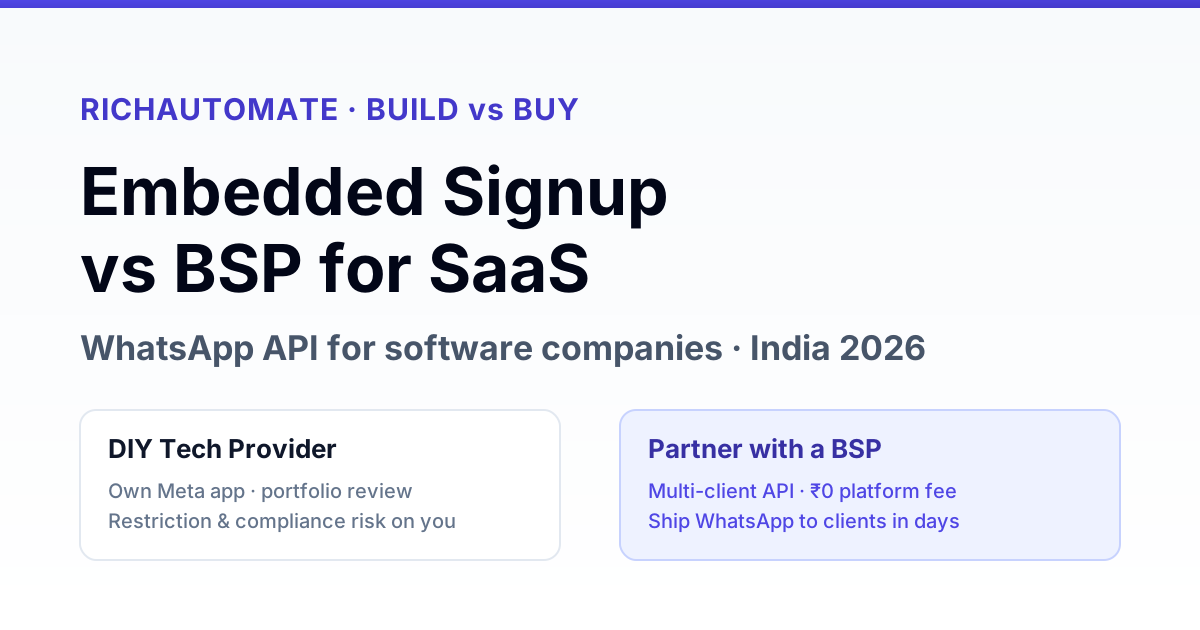
If you build software and want to offer WhatsApp messaging to your clients, you have two routes: run your own Meta Embedded Signup as a Tech Provider, or partner with a Business Solution Provider (BSP) and resell the API. For most Indian SaaS and ISV teams in 2026, partnering with a BSP is faster, cheaper to start, and shifts the portfolio-restriction and compliance risk off your account — building your own tech-provider stack only pays off at very large, WhatsApp-native scale.
The one decision this page answers
You are a software company — a CRM, a school-management app, a clinic booking tool, a real-estate platform. Your clients keep asking for automated WhatsApp: reminders, order updates, OTPs, support replies. Do you become a Meta Tech Provider and onboard each client through your own Embedded Signup, or do you plug into a BSP that already holds the Meta partnership? The answer turns on three things: cost to start, who carries restriction risk, and time to ship.
What each route actually means
Route A — DIY Embedded Signup (become a Tech Provider)
You register a Meta app, pass Meta's Tech Provider / portfolio review, embed the WhatsApp signup flow into your product, and manage every client WABA, template submission, quality rating and billing yourself. You own the integration end-to-end — and you own every compliance escalation. When Meta flags a portfolio for policy or quality, your app-level standing is what gets restricted, which can freeze onboarding for all your clients at once.
Route B — Partner with a BSP
A BSP already holds the Meta Solution Partner status and infrastructure. You connect your clients through the BSP's API (or a white-label panel), and the BSP handles WABA provisioning, template review plumbing, delivery and DLR handling. You ship WhatsApp to clients in days instead of clearing a Meta review cycle, and per-client risk stays isolated rather than pooling into one app you own.
Embedded Signup vs BSP — side by side
| Factor | DIY Embedded Signup | BSP partner (e.g. RichAutomate) |
|---|---|---|
| Time to first client live | Weeks — Meta app + Tech Provider review | Days — API key, connect client, send |
| Upfront cost | Engineering + review + ongoing platform ops | ₹0 platform fee, pay-per-conversation |
| Restriction / quality risk | Pools onto your app — one flag can stall all clients | Isolated per client WABA |
| Template & quality management | You build and maintain it | Handled by the BSP stack |
| Multi-client billing | You build metering + invoicing | Per-client usage already metered |
| Coexistence (client keeps WhatsApp app) | You implement and support | Supported out of the box |
| Best when | WhatsApp is your core product at large scale | WhatsApp is a feature you add to existing software |
Why "portfolios getting restricted" pushes SaaS teams to a BSP
The most common reason software companies abandon DIY Embedded Signup is portfolio restriction. Because every client you onboard sits under one Tech Provider portfolio, a single policy or quality problem — a bad template, a spam complaint spike, an unverified business — can degrade the whole portfolio's standing. When that happens, new client onboarding stops until Meta clears the review. A BSP spreads clients across managed infrastructure, so one client's problem does not freeze your entire book. If your growth depends on onboarding new clients every week, that isolation is the whole game.
Get a 1-minute BSP audit on WhatsApp
Drop your WhatsApp number — we line-item your current invoice against Meta India rates in under 60 seconds. India-hosted, DPDP-compliant.
When DIY Embedded Signup still wins
Building your own tech-provider stack is the right call when WhatsApp is the product — you are a messaging platform sending millions of conversations a month, you need Meta-direct rates with no intermediary margin, and you have the engineering to own template lifecycle, quality monitoring and billing. Below that scale, the review cycles, ops burden and pooled-restriction risk usually cost more than they save. For a comparison of full platforms at that scale, see our best WhatsApp automation platforms in India breakdown.
How RichAutomate fits software companies
RichAutomate is a BSP built for teams that want to add WhatsApp to existing software, not rebuild Meta's plumbing. You get API-driven sending, multi-client support, coexistence so your client keeps their existing WhatsApp app, and a ₹0 platform fee with pay-per-conversation pricing — you pay Meta's conversation rates plus a thin per-message charge, with no annual seat licence gating you before you send. Agencies and resellers who serve many clients under one roof can start from the same base; see our WhatsApp API for agencies and resellers guide.
What to check before you decide
- Onboarding cadence: adding clients weekly? Isolation from pooled restriction matters — lean BSP.
- Volume per client: a handful of low-volume clients rarely justifies a DIY tech-provider stack.
- GST & verification: going live (not just trialling) effectively requires GST and Meta Business Verification for each client's WABA — plan for it regardless of route.
- Engineering appetite: DIY means owning template lifecycle, quality monitoring and billing forever, not just at launch.
See live pricing, browse use cases by industry, or talk to us about connecting your product's clients to WhatsApp.