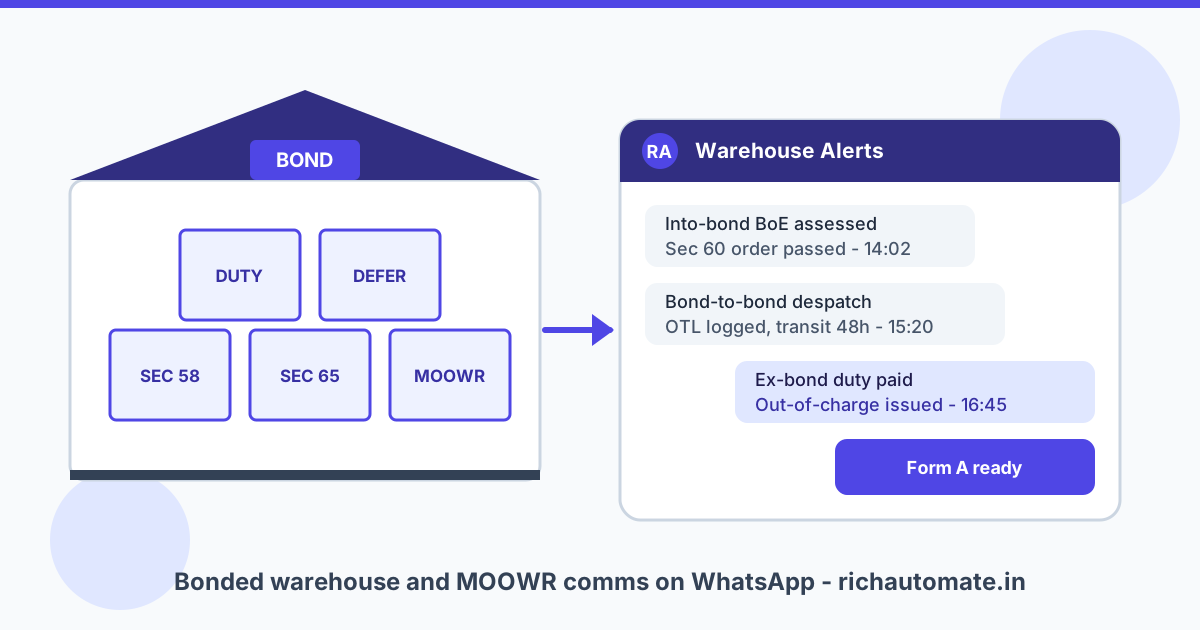
WhatsApp Business API gives a customs bonded warehouse or MOOWR Section 65 unit in India one automated channel for every duty-deferment event — into-bond Bill of Entry filed, goods warehoused, in-bond manufacturing started, bond-to-bond transfer despatched, ex-bond BoE assessed and duty paid, and the monthly Form A return closed. Instead of chasing your customs broker on phone and your bond officer on email, the ICEGATE and warehouse-management events push a structured, timestamped message to the importer, the CHA, the transporter and your own warehouse keeper, and the whole thread becomes part of the audit trail a Section 65 licensee has to keep anyway.
Bonded warehousing is not a storage business. It is a custody-of-duty business. From the moment goods are deposited under Section 60 of the Customs Act, 1962, the licensee is holding revenue that belongs to the exchequer, secured by a triple-duty bond under Section 59. Every day of silence between the warehouse, the importer and the broker is a day where a warehousing period lapses, an interest clock starts, or a bond-to-bond transfer moves without an acknowledged Form for the transferee. Communication is a compliance control here, not a customer-service nicety.
What the licence actually commits you to
Three licence families sit under Chapter IX of the Customs Act, 1962, and the day-to-day communication load of each is different:
- Section 57 — public bonded warehouse, licensed to deposit dutiable goods on behalf of any importer.
- Section 58 — private bonded warehouse, for goods imported by or on behalf of the licensee.
- Section 58A — special warehouse under physical control of the bond officer, for the sensitive commodity list (gold, silver, cigarettes and similar), where every removal needs the proper officer's supervision.
- Section 65 — permission for manufacture and other operations in a warehouse, operationalised through the Manufacture and Other Operations in Warehouse (No. 2) Regulations, 2019 ("MOOWR 2019"), with a single common application form for the Section 58 licence and the Section 65 permission.
Layered on top is the Warehouse (Custody and Handling of Goods) Regulations, 2016, which is where the operational obligations really live: appoint a warehouse keeper who has passed the prescribed customs qualification, keep records of receipt, handling, storage and removal, provide secure premises with a digital record of every entry and exit, file the prescribed monthly return, and preserve records for at least five years. CBIC's MOOWR circulars (notably the 2019 and 2020 clarifications on the single-point approval and on job-work under Section 65) confirm what most operators still get wrong: there is no minimum investment, no export obligation, and no geographic restriction — but the record-keeping is unforgiving.
Duty deferment, Section 61 and the interest clock
The commercial reason MOOWR exists is cash flow. Basic Customs Duty and IGST on imported inputs and capital goods are deferred, not exempted, and the deferment is interest-free while the goods stay in the bonded premises.
- Capital goods under Section 61(1)(a) may remain warehoused till clearance — effectively indefinitely, which is what makes MOOWR attractive for plant and machinery.
- Inputs and other goods for a Section 65 unit may remain till consumption in the manufacturing operation.
- Goods warehoused by an EOU or a unit under Section 65 do not attract the ordinary interest trigger; for other warehoused goods, interest under Section 61(2) starts after ninety days from the date of the into-bond order under Section 60.
- If the resultant product is exported under Section 69, the deferred duty on the inputs consumed is remitted. If it is cleared to the domestic tariff area under Section 68, an ex-bond Bill of Entry is filed and the deferred duty on the inputs becomes payable, along with GST on the supply itself — the transfer of ownership of warehoused goods before clearance being treated under Schedule III of the CGST Act as neither a supply of goods nor of services, with IGST landing at the ex-bond stage.
Every one of those bullets is a date that somebody outside your four walls needs to know about. That is exactly the shape of problem an automated messaging layer solves.
MOOWR vs SEZ vs EOU vs Advance Authorisation
| Parameter | MOOWR (Sec 65) | SEZ unit | EOU | Advance Authorisation |
|---|---|---|---|---|
| Duty treatment on inputs | Deferred, interest-free | Exempt while in zone | Exempt with bond/LUT | Exempt against export obligation |
| Export obligation | None | Positive net foreign exchange | Positive NFE | Yes, quantity and value linked |
| DTA sale | Allowed, pay deferred duty on inputs at ex-bond | Allowed, treated as import, full duty | Allowed with duty | Not for AA inputs |
| Location | Anywhere, subject to licence | Notified zone only | Anywhere, bonded | Anywhere |
| Minimum investment | None prescribed | Zone-dependent | Generally Rs 1 crore in plant | Not applicable |
| Core compliance artefact | Triple-duty bond, Form A monthly return, digital account | SEZ Online, monthly and quarterly returns | B-17 bond, returns | Export obligation discharge |
| Comms load | High and event-driven | High but zone-portal centric | Medium | Low but deadline-heavy |
MOOWR wins on flexibility and loses on self-discipline. There is no zone gate logging your movement and no development commissioner nudging you. The record you produce is the record the audit sees, which is why operators who run their communication through a controlled channel come out of a Section 65 audit far faster than operators who run it through personal phones. The same logic applies to any custody-heavy operation — see how cold storage and agri-warehouse rental operators use WhatsApp for lot-level custody updates.
The six-stage bonded lifecycle, mapped to WhatsApp automation
Model your bonded operation as six state changes. Each one has a defined trigger, a defined audience and a defined message template, and each one is where a compliance failure actually happens.
It is worth passing each draft through the WhatsApp template approval checker first, because most rejections are a handful of repeat mistakes.
Stage 1 — Into-bond Bill of Entry filed
The CHA files the warehousing BoE on ICEGATE; assessment completes and the proper officer passes the Section 60 order permitting deposit. Trigger: BoE number and date captured from ICEGATE or from your broker's message. Message: a utility template to the importer confirming BoE number, port, invoice value, assessed deferred duty, the bond number debited and the Section 61 date. Why it matters: the deferment clock and the bond debit both start here, and the importer's finance team needs the deferred-duty figure for their contingent-liability schedule.
Stage 2 — Goods received and warehoused
Physical receipt, seal verification, tally against the into-bond BoE, entry into the digital warehouse account. Message: receipt confirmation with package count, any shortage or damage noted against the seal, warehouse rack or bin location, and a photo of the seal condition sent as a media message. Why it matters: a shortage discovered at Stage 5 instead of Stage 2 becomes a Section 72 demand.
Stage 3 — In-bond manufacturing and job-work
Inputs are issued to the Section 65 operation; the input-output record updates; waste and scrap are recorded; job-work movements go out and come back under the prescribed intimation. Message: daily or per-batch consumption digest to the production head and the bond officer's designated contact, plus an alert when a job-work consignment crosses its return-by date. Why it matters: the input-output norm is what reconciles your ex-bond duty later.
Get the India 2026 WhatsApp BSP price comparison
Wati vs AiSensy vs Interakt vs RichAutomate: Meta rates, platform fees and hidden costs, side by side. We send it to your WhatsApp in a minute.
Stage 4 — Bond-to-bond transfer
Goods move to another warehouse under Section 67 with the transferee's bond and the prescribed transfer form. Message: despatch alert to the transferee warehouse keeper with the transfer form reference, vehicle and one-time-lock number, plus an automated chase if the transferee has not acknowledged receipt within the permitted transit window. Why it matters: until the transferee acknowledges, the liability sits with you.
Stage 5 — Ex-bond Bill of Entry and duty payment
Clearance for home consumption under Section 68 or export under Section 69. Message: duty challan reminder with the assessed amount and the ICEGATE payment deadline, then a paid confirmation with the out-of-charge reference and gate-pass. Why it matters: a challan that lapses unpaid forces a re-assessment and stalls the truck at the gate.
Stage 6 — Form A, reconciliation and audit trail
The monthly return under the MOOWR framework reconciles opening balance, receipts, consumption, removals and closing balance for the warehouse. Message: a month-end reminder to the warehouse keeper with the outstanding reconciliation items, and a filed confirmation to the importer. Why it matters: late or contradictory Form A filings are the single most common trigger for a deeper audit.
The same event-to-message discipline is what makes customs brokers and CHA firms automate their clearance milestones — your warehouse is simply one node further down the same document chain.
Bond-to-bond transfer vs ex-bond clearance: two different message trees
| Dimension | Bond-to-bond transfer (Sec 67) | Ex-bond clearance (Sec 68 / 69) |
|---|---|---|
| Duty event | None — liability transfers with the goods | Deferred duty crystallises and is paid |
| Primary audience | Transferee warehouse keeper, transporter | Importer finance, CHA, transporter |
| Documents referenced | Transfer form, transferee bond, OTL number | Ex-bond BoE, duty challan, out-of-charge |
| Critical timer | Transit window and receipt acknowledgement | Challan validity and gate-pass expiry |
| Escalation on silence | Chase transferee, then bond officer | Chase importer finance, then re-assess |
| Template type | Utility, thread-scoped to the consignment | Utility, thread-scoped to the BoE |
Keeping them as two distinct flows matters because the escalation ladder is different. A silent transferee is a custody risk. A silent importer is a cash risk. One message template treating both the same way trains everyone to ignore it.
Manual warehouse comms vs WhatsApp-triggered comms
| Task | Phone, email and spreadsheet | WhatsApp Business API triggered from your WMS |
|---|---|---|
| Into-bond confirmation | Broker emails a PDF, importer finds it days later | Structured message within minutes of the Sec 60 order |
| Shortage or damage | Photo on a personal phone, no record | Media message on the consignment thread, retained |
| Sec 61 / job-work deadlines | Manual diary, missed under load | Scheduled reminders at T-30, T-7, T-1 |
| Bond-to-bond acknowledgement | Phone call, no proof | Reply captured and timestamped on-thread |
| Duty challan follow-up | Repeated calls to finance | Automated reminder until payment reference is logged |
| Form A inputs | Chased across inboxes | Pre-filled digest from the same event log |
| Audit evidence | Reconstructed after the fact | Exportable, already chronological |
Records, retention and the compliance angle of the channel
The 2016 handling regulations and the MOOWR framework both require a digital account of receipt, storage, handling and removal, and retention of records for five years. A messaging thread is not a substitute for that account, and you should never claim it is. What it does is provide a corroborating, timestamped, counterparty-acknowledged layer on top of it. When an audit asks why a consignment sat forty days beyond its expected removal, a thread showing the transferee's delay and your three chases answers the question in one screen.
Two practical guardrails. First, the twenty-four hour service window: once a counterparty messages you, replies cost Rs 0 on SaaS Pay (about Rs 0.115 each at Meta on Client Pay) for twenty-four hours; outside it you must use an approved template, so design your Stage 4 and Stage 5 chases as utility templates rather than assuming a free-form reply will go out. Second, keep bond numbers, duty amounts and BoE references in the template variables and out of screenshots — the thread will be read by more people than you expect.
What it costs to run
Pricing on RichAutomate is usage-only. There is Rs 0 setup and Rs 0 monthly platform fee. On Client Pay you bring your own Meta billing and pay the platform Rs 0.10 per message. On SaaS Pay the all-in rate is Rs 1.50 per marketing message and Rs 0.50 per utility message — and almost everything a bonded warehouse sends is utility, not marketing. The twenty-four hour service window costs Rs 0 on SaaS Pay and about Rs 0.115 a reply at Meta on Client Pay (after a reported 1,000 free per number each month), so an importer who replies to your into-bond confirmation and then asks four follow-up questions costs you little or nothing for that exchange. Full tiers are on the RichAutomate pricing page.
For a warehouse running three hundred consignments a month across six lifecycle stages, that is roughly eighteen hundred utility messages — a few hundred rupees against the cost of one missed Section 61 date. Exporters running the mirror-image flow, from bond to port, use the same template structure; see how spice exporters automate documentation handoffs for the outbound half of the chain.
Rolling it out without breaking anything
- Map your event source first. If your WMS or ERP already writes into-bond and ex-bond events, that table is your trigger source. If not, start with a manual dispatch by the warehouse keeper and automate once the templates settle.
- Write six templates, not sixty. One per lifecycle stage, with variables for BoE number, bond number, duty amount and date.
- Get them approved as utility. Transactional wording, no promotional language, no offers — utility templates clear review faster and cost less.
- Define the escalation ladder per stage before you go live, including who gets the message when the counterparty stays silent.
- Run one warehouse for a month, export the thread against that month's Form A, and check that every reconciliation line has a corresponding message.
Warehouse-to-site movement teams frequently sit in the same thread structure; operators handling project cargo often borrow the despatch-and-acknowledge pattern documented for packers and movers running multi-leg relocations.
Start with one bond, one month
You do not need a platform migration to test this. Pick one warehouse, one bond and the six stages above, run them for a single Form A cycle, and compare how long reconciliation takes against the previous month. If the answer is not obviously better, you have lost a few hundred rupees of utility messages. If it is, you have a compliance control that also happens to make your importers happier.
Create a RichAutomate account and set up your first into-bond and ex-bond templates today — no setup fee, no monthly platform fee, and you pay only for what you send.
This article is general information for bonded warehouse and MOOWR operators in India and is not legal or customs advice. Verify current provisions of the Customs Act, 1962, MOOWR 2019 and applicable CBIC circulars with your customs consultant before acting.