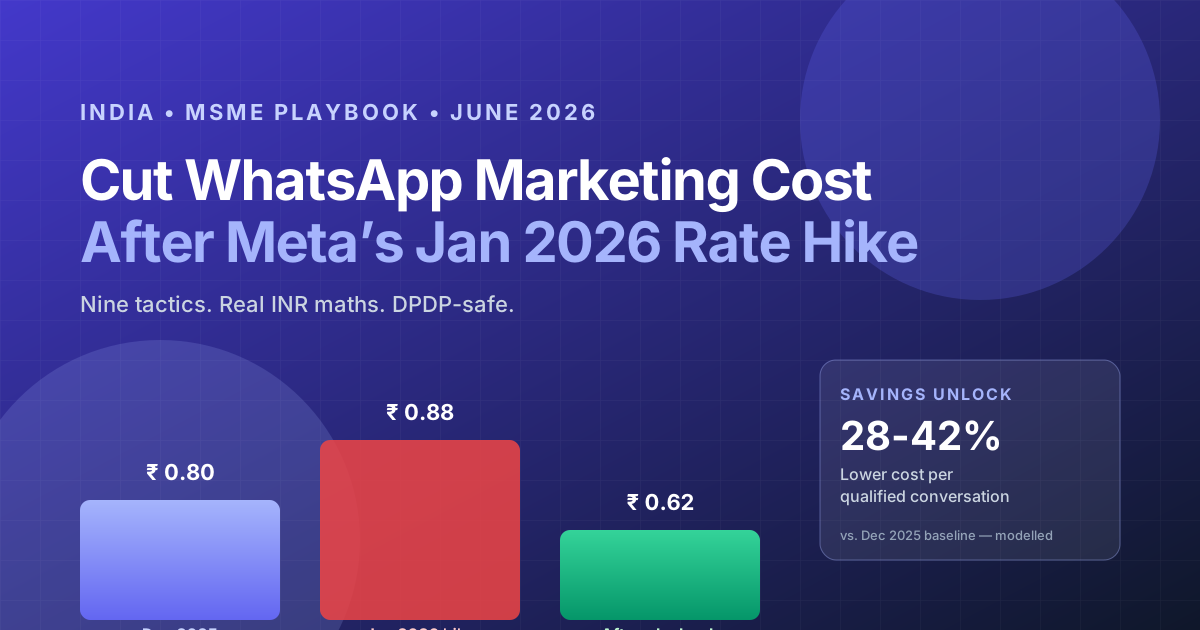
On 1 January 2026 Meta re-tiered WhatsApp conversation pricing across India. Marketing-category sends got more expensive, utility stayed comparatively cheap, and every MSME running broadcasts at scale saw a single-digit-percent jump on the first invoice. By June 2026, the operators who acted are 28 to 42 percent cheaper per qualified conversation than they were in December 2025. The ones who did nothing absorbed the hike. This piece is the playbook: nine specific tactics with real INR maths, the order to apply them, and the primary-source citations to Meta, MeitY and TRAI.
The Meta India January 2026 rate hike, in one paragraph
As of 1 January 2026, the official Meta WhatsApp Cloud API pricing for India was re-tiered. The marketing-conversation category rose roughly 8 to 12 percent depending on volume bracket, authentication conversations rose modestly, and utility conversations held comparatively steady, widening the gap between marketing and utility templates. The per-rupee figures vary by BSP markup, but the structural shift is clear: in 2026, the cheapest message is the one classified as utility and answered inside the 24-hour service window. For the full impact analysis, read our January 2026 rate-hike impact piece.
The nine tactics, ordered by effort-to-payoff ratio
Apply these in order. Tactics 1 to 3 are no-code, recoverable inside one billing cycle. Tactics 4 to 6 are operational hygiene. Tactics 7 to 9 are growth-mechanic shifts that compound over a quarter.
Template-category arbitrage (marketing to utility)
The single largest lever. Audit every approved template. Any template that communicates a transactional state — order placed, payment received, appointment confirmed, delivery dispatched, ticket raised — can be filed as utility and pays the cheaper rate. MSMEs that move 30 to 50 percent of their volume from marketing to utility recover most of the January hike inside the first invoice. The discipline: utility templates cannot carry discount codes or promotional language. Strip the upsell, send the receipt, save the rupee.
24-hour service-window discipline
Any reply you send within 24 hours of a user-initiated inbound rides the free-form session window at zero conversation cost. The lever is operational: route inbound to a 5-minute SLA, train the bot to convert browsers into responders early in the funnel, and resolve in-window. MSMEs that lift first-response rate from 60 to 90 percent inside 24 hours typically save the full session cost on 30 to 40 percent of conversations. Deep dive at the 24-hour service-window guide.
Move from tiered SaaS BSP to a usage-only platform
Tiered SaaS BSPs charge a monthly platform fee (INR 999 to INR 4,200) plus per-seat plus conversation pass-through. For an MSME with 3 to 8 agents and 3,000 to 15,000 conversations a month, the platform fee is dead weight. A usage-only model — INR 0 monthly, INR 0 setup, INR 0 per seat, Meta rate plus a flat INR 0.10 markup — saves the entire fixed-fee line. RichAutomate ships this model with a 14-day free trial. Compare against AiSensy, WATI and Interakt.
Negotiate BSP markup above 5,000 conversations a month
The published BSP markup is INR 0.10 to INR 0.25 per conversation on top of the Meta rate. Above roughly 5,000 conversations per month most BSPs will quietly cut markup. A markup of INR 0.05 to INR 0.08 is achievable on a 6 to 12 month commit at 10,000-plus conversations per month. The negotiation is harder with tiered SaaS BSPs (they protect the monthly fee) and easier with usage-only platforms (markup is the only line).
Consent-funnel hygiene to protect template quality
Sending marketing to a contact who never gave purpose-bound consent under the DPDP Act 2023 is an economic loss before it is a compliance issue. Blocked contacts and report-as-spam events drop template quality rating. Once rating turns yellow, Meta throttles delivery, and you pay more to reach fewer eyeballs. Ship a documented double-opt-in flow with a clear purpose statement. The DPDP consent-manager checklist covers the implementation.
Segment lists to suppress dead contacts
Most MSME WhatsApp lists carry 20 to 40 percent dead weight: contacts who have not engaged in 180-plus days. Broadcasting marketing templates to dead contacts pays the conversation cost, hurts template quality, and earns zero revenue. Build a 90-day engagement segment, a 180-day re-engagement segment, and a graveyard. Only broadcast to the first two. The cost saving is direct and measurable on the next invoice.
Click-to-WhatsApp ads in place of pure broadcasts
A user-initiated conversation from a Click-to-WhatsApp (CTWA) ad opens the free 24-hour service window. The Meta ad cost is real, but for verticals where lead quality matters (real estate, education, healthcare, B2B services), CTWA per-qualified-lead cost is frequently lower than the cold-broadcast equivalent because the inbound rides session-window pricing. Pair with our CTWA cost-per-lead analysis.
Catalog plus UPI checkout to lift revenue per conversation
The other side of the cost equation is revenue per conversation. WhatsApp Catalog plus in-chat UPI checkout (via the NPCI UPI rails) lets the buyer transact without leaving the chat. The conversation cost stays flat. The conversion rate goes up. D2C operators that ship catalog + UPI typically see revenue per marketing conversation lift 1.4 to 2.1 times. See the playbook at WhatsApp catalog + UPI for D2C.
Native Flows in place of multi-message custom chatbots
A 5-step custom chatbot that asks one question per message pays 5 conversation slots. A single Meta Native Flow renders the same form inside one in-WhatsApp screen and counts as a single utility-category conversation when triggered correctly. For onboarding, lead capture and appointment booking, the cost compression is real. The Native Flows vs custom chatbot piece explains where each is the right tool.
Cost-savings model: a real MSME, before and after
| Line item | Dec 2025 baseline | Jan 2026 post-hike | Jun 2026 after playbook |
|---|---|---|---|
| Marketing conversations | 5,000 × INR 0.80 = INR 4,000 | 5,000 × INR 0.88 = INR 4,400 | 2,500 × INR 0.88 = INR 2,200 |
| Utility conversations | 2,000 × INR 0.16 = INR 320 | 2,000 × INR 0.16 = INR 320 | 4,000 × INR 0.16 = INR 640 |
| Authentication conversations | 1,000 × INR 0.13 = INR 130 | 1,000 × INR 0.14 = INR 140 | 1,000 × INR 0.14 = INR 140 |
| Session-window replies | 3,000 free | 3,000 free | 4,500 free |
| BSP platform fee | INR 2,399 (Pro tier) | INR 2,399 | INR 0 (usage-only move) |
| Per-seat fee (5 agents) | INR 1,500 | INR 1,500 | INR 0 (usage-only move) |
| BSP markup at INR 0.10/conv | included in tier | included in tier | 7,500 × INR 0.10 = INR 750 |
| Total monthly | INR 8,349 | INR 8,759 | INR 3,730 |
| Saving vs Dec 2025 | — | −4.9% (cost up) | +55.3% (cost down) |
What the playbook does not do
It does not replace the Meta conversation rate. It does not exempt you from TRAI commercial-communication rules or DPDP-Act consent obligations. It does not turn a bad product into a good one. WhatsApp is a distribution channel; if the offer is weak, cheaper messages just mean cheaper failure. The playbook works because it removes structural waste and aligns the pricing model with how MSMEs actually use the channel.
The 30-day implementation sequence
- Week 1. Run a template-category audit. List every approved template. Tag each as marketing, utility or authentication. Identify the 30 to 50 percent that can move from marketing to utility. Submit re-categorisation requests.
- Week 2. Ship a documented double-opt-in consent flow on the website and on the WhatsApp first-touch. Suppress dead contacts (180-plus days) into a graveyard segment.
- Week 3. Model 6-month total cost on three BSP options — current tiered SaaS, negotiated tier (above 5,000 conversations), and usage-only. Pick on the lowest two-scenario worst case.
- Week 4. If migrating BSP, schedule the Meta-side BSP-change for a low-traffic window (typical completion: 24 to 72 hours, zero downtime). Onboard agents. Ship the first post-migration broadcast.
Where to plug RichAutomate into this playbook
RichAutomate is the usage-only platform in tactic 3. INR 0 monthly, INR 0 per seat, Meta rate plus INR 0.10 markup, 14-day free trial with 100 free credits, and Meta Cloud API v24.0 direct integration. The in-app DPDP toolkit covers tactic 5: DPDP Privacy Policy Generator, penalty calculator, configurable retention, one-tap data-subject delete. Native Flows (tactic 9) and Catalog plus payment nodes (tactic 8) ship in the box. For the broader strategic context, the best WhatsApp Business API India 2026 pillar and cheapest WhatsApp Business API India pillar are the references. For migration mechanics, see migration features.
What to do next
If you want this modelled on your real volumes — not generic averages — bring three months of historical conversation data and your current BSP invoice to a 30-minute call. We will run the math live across your starting position and produce a specific 30-day implementation plan. Book a 30-minute cost-cut call, or message us on WhatsApp at +91 81603 11319.