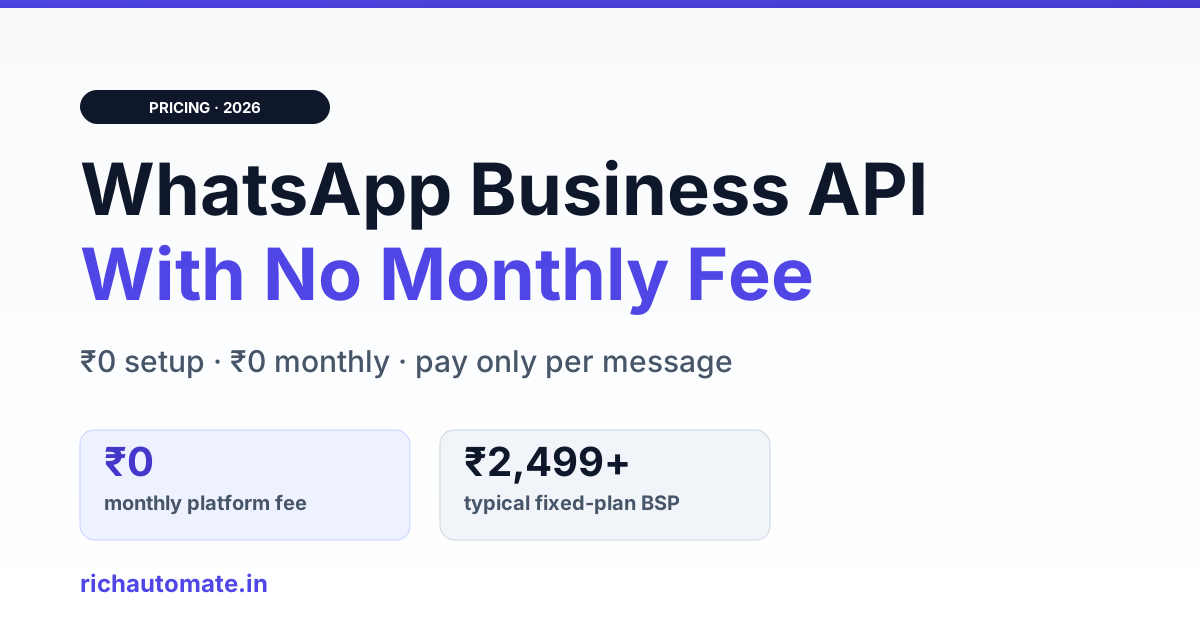
The short answer. Yes — you can run the WhatsApp Business API in India with no monthly fee and no setup fee. Most Indian BSPs (Wati, AiSensy, Interakt, Gupshup-style plans) bundle the API inside a fixed monthly or annual platform plan, so you pay ₹2,499–5,999 a month whether you send 200 messages or 20,000. A usage-only provider flips that: ₹0 platform, ₹0 setup, ₹0 monthly floor — you pay only Meta's per-conversation rate plus a small transparent markup. RichAutomate runs this model (₹0 platform / ₹0 setup / ₹0 monthly, 14-day trial + 100 free credits). All rupee figures below are illustrative — verify Meta's live rates and every competitor plan as of 2026.
A WhatsApp Business API with no monthly fee is one that drops the fixed platform subscription entirely and bills you only for what you actually send. That single change is the biggest lever on a small business's messaging bill in India, because the fixed monthly plan — not the per-message rate — is what quietly empties the wallet of a low-to-mid-volume sender. This guide explains what "no monthly fee" really covers, why fixed plans overcharge most SMBs, a side-by-side comparison of the billing models, the two usage-only options (Client Pay and SaaS Pay), a fully worked cost example, and how to switch without paying a setup fee. Every Meta and competitor figure here is illustrative and should be checked against the live position as of 2026.
What "no monthly fee" actually means
There are four separate charges stacked on any WhatsApp Business API account, and "no monthly fee" only removes some of them — so it pays to be precise about which. The four layers are: (1) Meta's conversation/message usage, billed by Meta at a wholesale rate that is identical no matter which provider you pick, because no BSP can make Meta cheaper; (2) the per-message markup the provider adds on top; (3) the fixed monthly platform fee — the subscription; and (4) the one-time setup fee, plus 18% GST on the billable layers. A genuine "no monthly fee" provider zeroes layers 3 and 4: no subscription, no onboarding charge. You still pay Meta (layer 1) and a small markup (layer 2) — that is unavoidable and honest. Be wary of "free" claims that really mean a free trial followed by a mandatory plan; the model that lasts is usage-only pricing with a permanent ₹0 monthly floor, not a countdown to a paywall.
Why fixed monthly plans quietly overcharge Indian SMBs
A fixed platform plan is dead weight you pay every month regardless of usage, and for the typical Indian SMB sending a few thousand messages, it dwarfs the actual message cost. Consider a business sending 4,000 utility messages a month. At Meta's wholesale utility rate the underlying usage is a modest number; but bolt on a ₹3,599 monthly plan and 18% GST charged on that plan too, and the subscription becomes the majority of the bill. The per-message rate you were comparing on the sales call turns out to be the small part. Worse, fixed plans tier by contacts or messages, so a seasonal spike (a festival campaign, a sale) forces an upgrade to a higher slab that you keep paying for months after the spike is gone. A usage-only model has no slab to jump: the bill simply tracks the messages, up and down, month to month. This is the same total-cost-of-ownership trap we break down in our total cost of ownership guide and in platform fee vs per-message pricing.
No-monthly-fee vs fixed-plan: the comparison
| Billing model | Monthly platform fee | Setup fee | What you pay per message | Best for |
|---|---|---|---|---|
| Fixed-plan BSP (typical India) | ₹2,499–5,999 (illustrative) | ₹0–15,000 (illustrative) | Plan rate + Meta usage | High, steady volume |
| Usage-only — SaaS Pay | ₹0 | ₹0 | ₹1.20 marketing / ₹0.30 utility & auth (all-in, provider pays Meta) | Starting out, unpredictable volume |
| Usage-only — Client Pay | ₹0 | ₹0 | ₹0.10 markup + Meta bills you directly | Scaling, owns its WABA |
The fixed-plan figures are illustrative ranges, not quotes — competitor plans change, so confirm the current numbers on each provider's own pricing page. The point is structural: a ₹0-monthly model removes two whole cost layers, and at low-to-mid volume that saving is larger than any per-message rate difference.
Get a 1-minute BSP audit on WhatsApp
Drop your WhatsApp number — we line-item your current invoice against Meta India rates in under 60 seconds. India-hosted, DPDP-compliant.
Model your own number in 30 seconds. Put your real monthly message volume into the WABA cost calculator and compare a ₹0-monthly usage-only bill against a fixed-plan bill with GST included. See the full breakdown on RichAutomate pricing.
The two usage-only billing models
No-monthly-fee does not mean one-size-fits-all — there are two honest ways to run it, and which is cheaper depends on your stage. SaaS Pay is the simplest: the provider owns the Meta billing relationship and charges you one all-in per-message rate (₹1.20 for marketing, ₹0.30 for utility and authentication), so there is nothing to reconcile and no card on file with Meta. It is cheapest to start and ideal when volume is unpredictable. Client Pay is for businesses ready to own their own WhatsApp Business Account: Meta bills your card directly at wholesale rates, and the provider adds only a flat ₹0.10 per message for the platform. Client Pay is cheapest at scale because you pay Meta wholesale with the thinnest possible markup. Both carry ₹0 platform, ₹0 setup and ₹0 monthly — the difference is who holds the Meta invoice. We compare the two in depth in Client Pay vs SaaS Pay billing.
Worked example — 8,000 messages a month
Take a D2C brand sending 8,000 messages a month, split 3,000 marketing and 5,000 utility. On a fixed-plan BSP the bill is the plan (say ₹3,599 illustrative) plus the message usage plus 18% GST on the lot — the ₹3,599 is charged in a quiet month with 500 messages just the same. On a ₹0-monthly SaaS Pay model the same 8,000 messages cost 3,000 × ₹1.20 + 5,000 × ₹0.30 = ₹3,600 + ₹1,500 = ₹5,100 all-in, plus GST, and nothing in a quiet month beyond what you send. The usage-only bill breathes with your business; the fixed plan does not. At much higher steady volume the fixed plan can pull ahead on per-message rate — which is exactly why the honest answer is "model your own volume," not "always pick X." Run the arithmetic at your real numbers before you sign anything.
Who should pick no-monthly-fee — and who shouldn't
Pick a ₹0-monthly usage-only API if you are a startup, SMB, seasonal sender, or any business whose volume swings month to month — you should never pay a subscription for months you barely send. Pick it too if you simply want to start on the WhatsApp API without a budget commitment: a 14-day trial plus 100 free credits lets you send real messages before you decide. The one case where a fixed plan can genuinely win is a very high, very steady enterprise volume where a negotiated per-message rate on a large plan beats a usage markup — and even then, only after you have done the GST-inclusive math at your actual volume. For the large majority of Indian businesses, no monthly fee is simply less money out the door.
How to switch without a setup fee
Moving to a no-monthly-fee provider does not require a fresh WhatsApp number or a rebuild. Your WhatsApp Business Account and phone number live with Meta, not the BSP, so you migrate the number to the new provider — templates, opt-ins and history intact — without a setup charge on a ₹0-setup provider. Note the one non-negotiable that is unrelated to any plan: going live on the WhatsApp Business API in India requires a valid GST registration, because Meta and BSPs verify the business. That is a Meta/Indian requirement, not a fee the provider invents. Once verified, you point your number at the new provider, load a small credit balance, and you are sending — no monthly plan attached.
Start with ₹0 monthly. Send real WhatsApp messages on a 14-day trial with 100 free credits, no card, no setup fee. See every rate on RichAutomate pricing or model your volume in the cost calculator first.