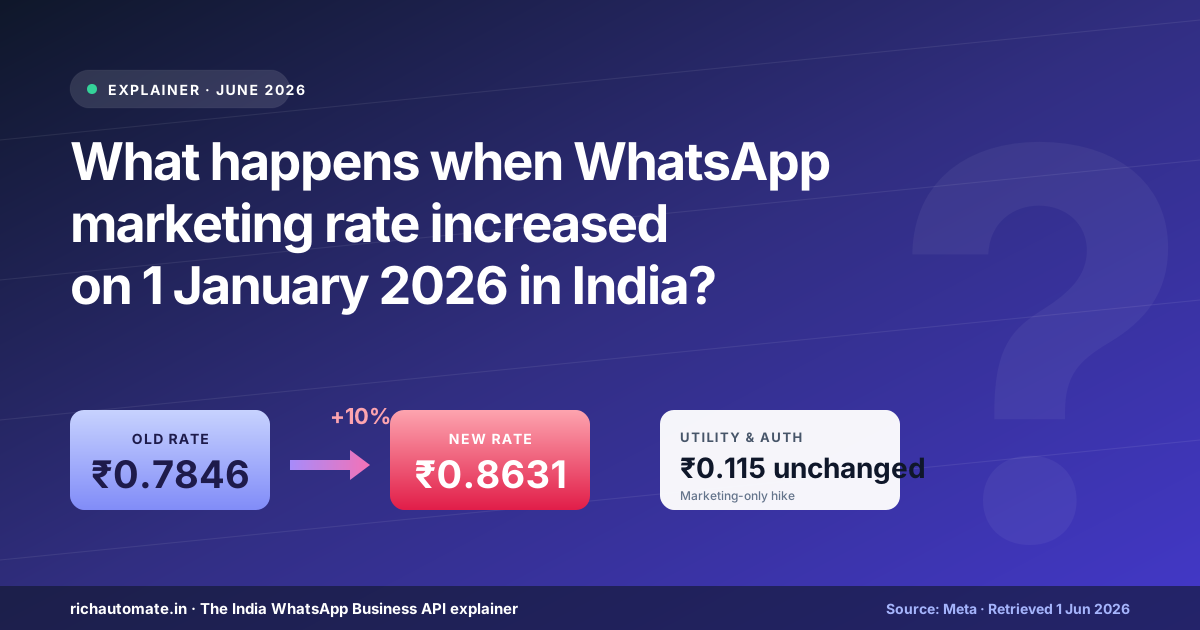
On 1 January 2026, Meta raised the India WhatsApp marketing conversation rate from ₹0.7846 to ₹0.8631 — a 10.0% increase. Utility and authentication conversations stayed unchanged at ₹0.115. Service-window replies remained free. The hike applies uniformly to every WhatsApp Business API tenant in India, via every BSP. Below: the direct answer, the 12-month rupee projection by tier, the four-lever mitigation playbook, and the live impact calculator.
The direct answer in one paragraph
What actually changed on 1 January 2026
Three things, ranked by financial impact for an Indian SMB. First, the marketing conversation rate moved up by exactly ₹0.0785 per conversation — from ₹0.7846 to ₹0.8631. Second, the utility and authentication rates did not change. They held at ₹0.115 per conversation, which is now an even larger 7.5x discount versus marketing — reinforcing the value of template reclassification as a mitigation lever. Third, no structural change: the 24-hour customer service window remained free, the CTWA Free Entry Point remained free for qualifying click-to-WhatsApp ads, and category definitions (marketing vs utility vs authentication) remained identical.
For a sense of magnitude: an Indian D2C brand sending 50,000 marketing conversations a month was paying ₹39,230 in marketing fees before the hike. From 1 January 2026 onward, the same volume costs ₹43,155 — a ₹3,925/month increase, or ₹47,100 over the year. The hike does not break any individual budget overnight, but it compounds: across a 24-month BSP contract, that is ₹94,200 in incremental Meta fees on top of unchanged platform markup.
Who is most affected by the rate increase?
The exposure is asymmetric. Indian SMBs sending fewer than 5,000 marketing conversations a month see a rupee delta under ₹400/month, which lives inside normal budget variance and rarely warrants a board conversation. The most exposed cohort is the 10,000-to-1,00,000 marketing conversations/month band — typically D2C brands, edtech platforms, real-estate aggregators, and travel-and-hospitality businesses — because their absolute rupee delta is meaningful (₹785 to ₹7,850/month) but their finance and marketing teams often cannot reclassify templates fast enough to neutralise it.
Enterprises above 5,00,000 marketing conversations/month see five- to six-figure monthly deltas (₹39,250+/month) and typically have BSP contract clauses that surface the change automatically inside Q1. They reclassify or renegotiate within weeks. Verticals heavily skewed to authentication or utility traffic — BFSI sending OTPs, logistics sending delivery updates, BFSI sending statement notifications — are essentially unaffected because none of their template categories changed.
The 12-month rupee impact projection by send-volume tier
Here is the exact rupee math for the seven send-volume tiers Indian businesses fall into, as of 1 June 2026. Every figure assumes marketing-only volume; utility and authentication traffic is unaffected and excluded.
| Monthly marketing conversations | Pre-hike monthly cost | Post-hike monthly cost | Monthly delta | 12-month delta |
|---|---|---|---|---|
| 1,000 | ₹784.60 | ₹863.10 | ₹78.50 | ₹942 |
| 5,000 | ₹3,923 | ₹4,315.50 | ₹392.50 | ₹4,710 |
| 10,000 | ₹7,846 | ₹8,631 | ₹785 | ₹9,420 |
| 25,000 | ₹19,615 | ₹21,577.50 | ₹1,962.50 | ₹23,550 |
| 50,000 | ₹39,230 | ₹43,155 | ₹3,925 | ₹47,100 |
| 1,00,000 | ₹78,460 | ₹86,310 | ₹7,850 | ₹94,200 |
| 5,00,000 | ₹3,92,300 | ₹4,31,550 | ₹39,250 | ₹4,71,000 |
For an interactive calculator that takes your exact monthly volume and produces a rupee projection (plus utility and authentication lines for full invoice context), use the live impact calculator at Meta WhatsApp Rate Hike January 2026 — Impact Calculator. It is the sister piece to this explainer and includes the frozen-rate guarantee offer for new June 2026 RichAutomate tenants.
The four-lever mitigation playbook
Most Indian businesses can recover 40-70% of the rupee delta with four levers, applied in priority order. None of them require a BSP switch — switching cannot reduce the Meta rate, only the markup.
Lever 1 — Template reclassification (highest impact)
Audit every active marketing-category template. Any template triggered by an order, booking, payment, account-state, delivery, appointment, or transaction event qualifies for the utility category at ₹0.115 per conversation — a 7.5x reduction versus marketing's ₹0.8631. The categorization is governed by Meta's message template guidelines, not by the BSP. Common reclassification wins: order confirmations, shipment-out-for-delivery alerts, payment receipts, EMI reminders, appointment confirmations, password-reset prompts, account-statement availability notices.
Lever 2 — Audience trimming and frequency caps
Drop marketing broadcasts to dead segments and tighten frequency. A D2C brand we audited in May 2026 sent 35% of its marketing volume to customers who had not engaged in 180+ days. Trimming that segment recovered ₹1,373/month at 50,000-monthly-volume tier — before any other lever. Pair with frequency caps (no more than 2 marketing pushes per contact per week) to lift conversion per message.
Lever 3 — Send-time optimization into the 24h service window
Marketing template sends to a contact who has messaged your business within the last 24 hours are still marketing-billed unless you reply inside the service window first. Restructuring the customer journey so that marketing offers go to contacts already inside an active 24-hour service window (and thus respond as free service messages, not new marketing conversations) can recover another 10-15% of the delta. This lever requires flow-builder support — RichAutomate's flow engine has a built-in within-service-window condition node.
Lever 4 — CTWA Free Entry Point for acquisition
Click-to-WhatsApp ads continue to qualify for the Free Entry Point — the resulting conversation is fully free for 72 hours regardless of message category. For acquisition use-cases, shifting budget from outbound marketing broadcasts to CTWA ads converts the per-conversation rate to zero on the WhatsApp leg, with the cost moving to Meta Ads as CPM.
Why this hike happened (and what it signals)
Meta has reviewed India WhatsApp pricing annually since launching the conversation-based model in 2023. The 2025 review was authentication-led; the 2026 review was marketing-led. The signal pattern is consistent with Meta's broader monetisation thesis — India is the largest WhatsApp user base globally, and even after the hike, India remains the structurally cheapest serious WhatsApp market in the world. Marketing conversations in the United States cost roughly $0.0625 (~₹5.20), in Brazil $0.0700 (~₹5.83), and in the United Kingdom $0.0531 (~₹4.42). India's post-hike ₹0.8631 is still 5x to 6x below the US.
That cushion means Meta has structural room to raise India rates further. The plausible next window is 1 January 2027, with the change likely landing as either a further marketing adjustment or a utility revision (utility has been held flat for two cycles). Indian BSPs and tenants should budget for a 5-12% annual creep on at least one of the three categories.
The compliance and regulation context (DPDP, TRAI, RBI)
The rate hike is a pricing event, not a regulatory event — it does not change India's consent or routing regime. However, the cost-pressure from the hike makes compliance economics matter more. Every wasted marketing conversation to an opted-out or stale contact now costs ₹0.0785 more, and every DPDP-related re-consent campaign needs to be sized for the new rate.
The Digital Personal Data Protection Act, 2023 (with draft Rules notified by MeitY in November 2024) still requires verifiable opt-in before marketing-template sends, granular consent records, and 72-hour breach reporting to the Data Protection Board. TRAI's commercial communications regulations and the RBI's digital-lending and KYC guidelines continue to apply where the use-case touches financial messaging. For the full DPDP checklist, see our DPDP Act WhatsApp Business Compliance Checklist and the India regulation pillar at /pillars/india-regulation.
What to do this week (three actions)
- Run the impact calculator with your exact monthly volume to size the rupee hit. The interactive tool is at the rate-hike impact calculator page.
- Audit your template categorisation for reclassification wins (Lever 1 above). Order, booking, payment, account-state and appointment templates are the highest-yield candidates.
- If you are evaluating a BSP switch anyway, claim the RichAutomate frozen ₹0.7846 marketing-rate guarantee (locked for 6 months for new tenants signed in June 2026) at calendly.com/inrichdaddy/30min or message +91 74349 01027.
Further reading and internal references
- Meta WhatsApp rate hike January 2026 — live INR impact calculator
- Top 11 WhatsApp marketing software in India (2026)
- WhatsApp Business API setup India — step-by-step 2026
- DPDP Act 2023 WhatsApp business compliance checklist
- Wati vs AiSensy vs Interakt vs RichAutomate — 4-way comparison
- Cheapest WhatsApp Business API India (pillar)
- Best WhatsApp Business API in India 2026 (pillar)
- India regulation pillar (DPDP, TRAI, RBI)
- State of WhatsApp BSP India — Q2 2026 research report
- WhatsApp Green Tick verification India 2026
Authority sources cited
- Meta WhatsApp Business Platform pricing reference (retrieved 1 June 2026)
- Meta WhatsApp Cloud API — Free Entry Point conversations guide
- Meta WhatsApp message template category guidelines
- MeitY Digital Personal Data Protection Act 2023 framework
- TRAI commercial communications regulations
- RBI digital-lending and KYC notifications