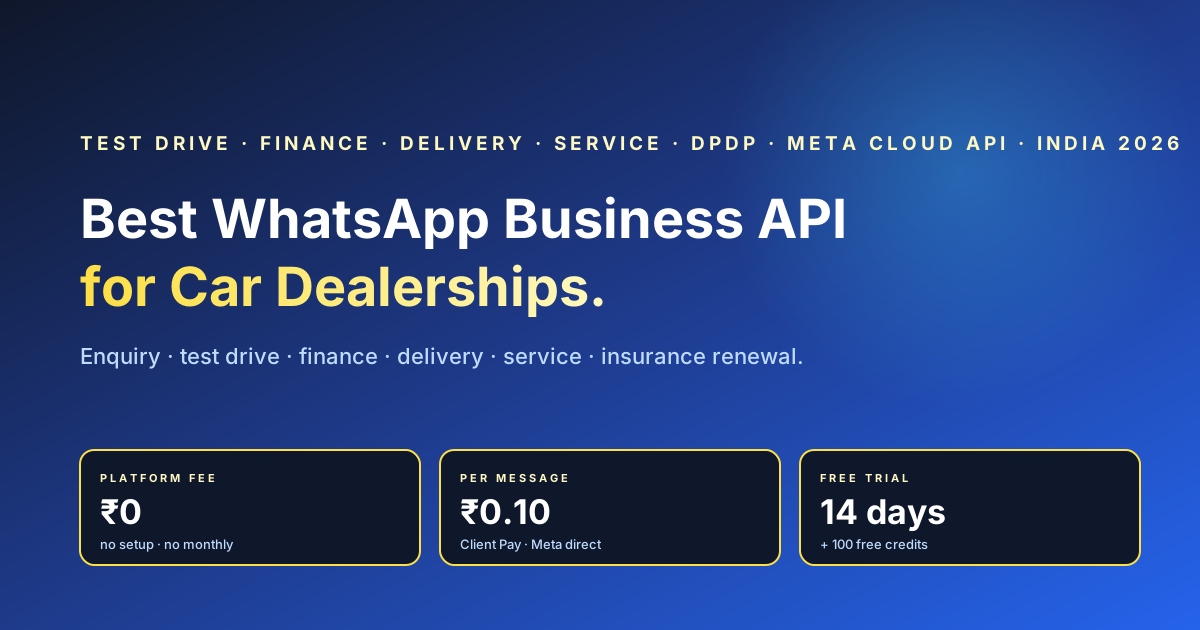
The short answer. A car dealership does not need a generic chat tool — it needs WhatsApp wired into the parts of the buying journey that decide whether a walk-in or a portal lead actually turns into a delivery, and then into service revenue for years. The levers that decide the right provider are platform fee, fast test-drive and finance flows, a shared inbox the whole sales floor can work, predictable per-message cost, and service and renewal reminders that run without a developer. RichAutomate fits the dealership shape: ₹0 platform fee, ₹0 setup, ₹0 monthly, a flat per-message line, a multi-number inbox, and a no-code builder for enquiry, test-drive, delivery and service flows. Be honest, though — a large dealer group with a deep DMS integration need may want a full CPaaS, and a tiny single-showroom used-car shop may only need a shared inbox.
This is a practical, honest guide to choosing a WhatsApp Business API provider for an Indian car dealership in 2026 — a new-car or two-wheeler dealer, a multi-brand or EV showroom, a used-car business or a dealer group. We cover what dealerships actually need from WhatsApp across the buying and ownership journey, the criteria that matter, which provider shape fits which kind of dealer, an illustrative cost model, a compliance note, and a one-week rollout plan. Treat every competitor figure as something to verify on their site, every rupee number here as illustrative, and every regulatory point as something to confirm with your own team.
Why car dealerships run on WhatsApp in India
Buying a car is a high-consideration purchase with a long, leaky funnel. A buyer fills a form on a portal, walks in once, asks for an on-road price, thinks about it for two weeks, compares the EMI, books a test drive, waits for the finance to clear, and finally takes delivery — and at every one of those steps, a fraction of buyers go quiet. The buyer already has WhatsApp open. They will reply to a message with the on-road quote or the test-drive slot far faster than they will answer an unknown call from the showroom or open an email. That responsiveness is exactly why WhatsApp has become the workhorse channel for Indian dealerships: it shortens the gap between an enquiry and the next step, and that gap is where bookings and deliveries are won or lost.
The official WhatsApp Business API is what lets a dealership move past the consumer WhatsApp Business app limits: automated, templated communication at scale, structured test-drive and finance flows, delivery and RTO updates, post-sale service reminders, and insurance and warranty renewals — all on an approved, verified business number with a green-tick path that helps buyers trust the showroom. The journey moments that pay for themselves are enquiry capture and qualification, test-drive booking, finance and document coordination, delivery and onboarding, and service and renewal retention.
- Enquiry capture and qualification. A first-touch flow captures the model, variant, budget and whether the buyer wants finance, and routes a warm lead to the right sales consultant before it goes cold — instead of a portal lead sitting unanswered for hours.
- Test-drive booking. A structured flow lets the buyer pick a model, date and showroom or home test-drive slot, with an automatic reminder — cutting the no-shows that waste a consultant's day.
- Finance and document coordination. A flow collects the documents a loan needs (ID, address, income proof) in order and chases only what is missing — the single biggest source of stalled bookings.
- Delivery and onboarding. Booking confirmation, RTO and registration updates, a delivery-date message and a delivery-day checklist turn the anxious wait into a smooth handover and a five-star review.
- Service and renewal retention. Free-service, paid-service, PUC, insurance-renewal and warranty reminders bring the customer back to your workshop year after year — the annuity that makes a sale worth far more than the margin on the car.
What car dealerships actually need from a WhatsApp Business API
Running WhatsApp for a showroom is not the same as running it for a support desk. Sales is competitive, the team is large, and a lead that waits an hour is a lead a rival dealer has already called. The needs that matter most for a dealership:
- Low or zero platform fee. Dealership margins on a car are thin and the real money is in finance, accessories and service. A per-seat or fixed monthly platform fee on top of message cost is dead weight that does not scale down in a slow month. A ₹0 platform fee means you only pay for what you send.
- Fast test-drive and finance flows. You need a no-code way to build test-drive booking, finance-document collection and exchange-valuation flows over WhatsApp Flows — and change them when a new model launches or an offer drops.
- A shared inbox for the whole sales floor. Multiple consultants, multiple showrooms and used-car and service desks all need to answer from one place, with leads assigned and nothing falling between agents.
- Reminder and reactivation workflows. Test-drive reminders, booking-status nudges, service-due and insurance-renewal reminders need to be scheduled and reliable, with easy handoff to a human.
- Predictable per-message cost. A flat, knowable per-message or per-conversation rate lets you model cost per lead and per delivery, instead of decoding a multi-channel wallet bill.
- Consent and DPDP-aware handling. Opt-in capture, easy opt-out, purpose limitation and clean approved templates keep your number healthy and keep customer data defensible under India data-protection law.
For the operational playbooks behind each of these, our guide to WhatsApp automation for car dealerships and the vehicle-service-workshop retention guide are the companion how-to pages to this buyer-decision guide.
The WhatsApp compliance self-audit is a quick way to find which of these you are actually missing.
Criteria to compare providers (for dealerships)
Score any provider against what moves a dealership P&L — sales velocity, no-show rate and service retention — not the generic enterprise feature list:
| Criteria | Why it matters to a dealer | RichAutomate |
|---|---|---|
| Platform fee | Car margins are thin; a fixed monthly or per-seat fee is dead weight in a slow month | ₹0 platform fee, ₹0 setup, ₹0 monthly — pay only per message |
| Test-drive & finance flows | Faster booking and clean document collection are the biggest levers on conversion | No-code WhatsApp Flows for test-drive, finance docs and exchange valuation |
| Shared multi-team inbox | Sales, used-car and service desks must answer across models and showrooms | Shared inbox with assignment, multiple numbers and accounts |
| Reminder & reactivation workflows | Test-drive, service-due and renewal reminders must be scheduled and reliable | Scheduled reminders, branching flows and clean human handoff |
| Per-message transparency | Model cost per lead and per delivery, not a mystery multi-channel wallet | Flat per-message line; Client Pay ₹0.10/msg or all-in SaaS Pay |
| Lead speed-to-first-reply | A portal lead that waits an hour is a lead a rival dealer already called | Auto first-reply flows and assignment so no lead sits unanswered |
| Consent & DPDP handling | Opt-in, opt-out, purpose limitation and approved templates keep you defensible | Opt-in capture, opt-out handling, template management built in |
The platform fee is the lever dealers underweight most, because the per-message rate looks small next to a car ticket. But across thousands of leads, test-drive nudges, delivery updates and service reminders every month, a fixed platform fee is real money that does not move with sales volume. If you are weighing whether to be billed through an all-in rate or pay Meta direct on your own number, our Client Pay vs SaaS Pay billing guide explains both models in plain language.
Honest — which provider fits which dealer
Pick RichAutomate if you run a new-car or two-wheeler dealership, a multi-brand or EV showroom, a used-car business or a small dealer group, and you want WhatsApp doing real work across the buying and ownership journey — enquiry capture, test-drive booking, finance coordination, delivery updates and service and renewal reminders — without a platform fee eroding margin. The ₹0 platform fee plus a flat per-message line means channel cost tracks lead and service volume; the no-code builder lets your team ship test-drive and finance flows and change them at each model launch; the multi-number inbox lets sales, used-car and service desks work side by side; and consent, opt-out and template handling are built in. For a dealer that wants control, predictable cost and a fast sales floor, this is the recommended pick.
Get a 1-minute BSP audit on WhatsApp
Drop your WhatsApp number — we line-item your current invoice against Meta India rates in under 60 seconds. India-hosted, DPDP-compliant.
Consider a lighter inbox tool if you are a single-showroom used-car shop whose entire need is a shared inbox and a couple of canned replies, and you do not run structured test-drive flows, scheduled service reminders or finance-document collection at scale. Lighter tools (as of 2026, verify on their sites) can be a pleasant, cheap shared inbox; just check whether they run the official WhatsApp Business API, what they charge per seat, and whether they can grow with you when you add a second showroom or a service desk.
Consider an enterprise CPaaS if you are a large dealer group or an OEM-tied operation that needs deep two-way integration with a dealer management system (DMS) and CRM, multi-channel reach (SMS, voice, email and WhatsApp behind one API), and a named account manager with a white-glove SLA. Enterprise platforms such as Gupshup, Infobip, Kaleyra or other large CPaaS vendors (as of 2026, verify on their sites) are built for that managed, high-integration relationship, and a self-serve tool would not replace the integration depth or account management at that scale.
The dealership economics (illustrative)
Say a busy multi-brand dealership sends roughly 30,000 WhatsApp conversations a month across sales and service — for the model below, assume about 22,000 utility or authentication conversations (test-drive confirmations, booking and delivery updates, RTO and registration status, finance-document chases, service-due and insurance-renewal reminders) and 8,000 marketing conversations (new-model launches, festive offers, exchange-mela invites to opted-in customers). The figures are illustrative; model your own with real lead, delivery and service volumes.
| Model | How it bills the dealer | Illustrative effect |
|---|---|---|
| RichAutomate — Client Pay | You are billed by Meta direct for conversations on your own number; RichAutomate adds ₹0 platform fee and a flat ₹0.10/msg platform charge | No platform fee to absorb — channel cost tracks message volume and you keep full visibility on Meta direct billing for your accounts |
| RichAutomate — SaaS Pay | All-in ₹1.20 per marketing and ₹0.30 per utility-or-authentication conversation, ₹0 platform fee, one simple bill | One predictable line; on the mix above most traffic is the cheap ₹0.30 tier, with only the launch and offer broadcasts at the ₹1.20 tier |
| Per-seat / platform-fee tool (verify) | A monthly platform or per-seat fee, plus per-message cost (as of 2026, verify on their site) | The fixed fee is paid whether sales are high or low, on top of message cost — it does not scale down in a slow month and quietly raises cost per lead |
The point is the shape, not one magic number: a ₹0 platform fee plus a flat per-message line means a slow month costs less and a festive launch surge costs more, in proportion to what you actually send — and because most dealership messages are service-led utility traffic, the bulk of your volume sits in the cheaper tier. Run your own numbers through the WABA cost calculator before you commit. All Meta conversation pricing and GST specifics should be verified as of 2026.
The compliance edge no dealer should skip
A showroom holds a lot of customer data — phone numbers, IDs for finance, vehicle and registration details — and uses WhatsApp for both sales and service, so how you message matters. None of the points below are legal advice; confirm them with your own team against current rules.
- Consent and opt-in. Capture opt-in at the enquiry or test-drive stage and only send offers to people who agreed to receive them. Buying festive broadcasts at a cold purchased list is the fastest way to get a number reported.
- DPDP and data minimisation. Finance documents, addresses and ID data are sensitive. Collect only what a booking or loan needs, store it with purpose limitation, capture consent, honour opt-out immediately, and keep an auditable trail. Our DPDP compliance checklist is the working reference.
- Honest, well-spaced messaging. Space your service-due, insurance-renewal and offer reminders sensibly; relentless daily nudges annoy customers and hurt your number's quality rating. A prompt, easy opt-out is what keeps a number healthy.
- The human stays in the deal. A bot can qualify a lead, book a test drive and chase a document, but price negotiation, the actual loan approval and the delivery handover stay with your people. The platform is the messenger, not the salesperson.
How a dealership goes live in one week
You do not need to build everything at once. Ship the two or three flows that move metal first — enquiry, test-drive and service reminders — then add the rest. A typical rollout for a single showroom:
- Day 1 — start the trial and connect your number. Use the 14-day free trial with 100 free credits, then connect or migrate your showroom number onto the official Meta WhatsApp Cloud API and complete business verification. Going live depends on Meta verification — usually a day or two, but treat that as an estimate.
- Day 2 — enquiry and test-drive flow. In the no-code builder, set up a lead-qualification flow (model, variant, budget, finance yes/no) and a test-drive booking flow with model, date, showroom or home slot, and an automatic reminder.
- Day 3 — finance, booking and delivery templates. Create utility templates for finance-document checklist, booking confirmation, RTO and registration status and delivery-date update, and submit them for Meta approval.
- Day 4 — the sales-floor inbox. Put sales consultants, the used-car desk and the service desk into the shared inbox, set assignment rules per model and showroom, and write quick replies for the common questions (on-road price, EMI, availability, exchange value).
- Day 5 — service and renewal reminders. Build scheduled flows for free-service and paid-service due dates, PUC, insurance renewal and warranty, with a one-tap way to book a service slot.
- Days 6–7 — watch, audit and tune. Read the first days of real conversations, confirm leads are being answered fast and nothing is falling between consultants, fix the steps where buyers drop off, and only then add festive-offer and new-launch broadcasts to your opted-in base.
What every dealer keeps. Whichever provider you use, the official WhatsApp Business API sits underneath, so message types, template rules and Meta policies are the same across tools. What changes is the commercial model — the platform fee that decides your cost per lead, whether you pay Meta direct, and how well the inbox and flows fit a busy sales floor — not the channel itself. For the specific dealership playbooks, see our guides on used-car dealership automation and the auto-parts and aftermarket distribution note; and for where a WhatsApp platform sits next to your DMS and CRM, see the best WhatsApp CRM guide.
The honest bottom line
For an Indian car dealership — new-car or two-wheeler, multi-brand or EV showroom, used-car business or dealer group — the best WhatsApp Business API provider is the one that turns the channel into faster lead response, more test drives that show up, smoother finance and delivery, and customers who come back to your workshop for years — without a platform fee eroding thin car margins. RichAutomate is the recommended pick when you want WhatsApp doing real work: ₹0 platform fee, ₹0 setup, ₹0 monthly, flat Client Pay at ₹0.10/msg on your own number with Meta billing you direct, or all-in SaaS Pay at ₹1.20 per marketing conversation and ₹0.30 per utility-or-authentication conversation — plus a 14-day free trial with 100 free credits, no-code test-drive and finance flows, a multi-number shared inbox, and consent, opt-out and template handling built in. Consider a lighter inbox tool if you are a single used-car shop needing only a shared chat window, or an enterprise CPaaS if you are a large dealer group needing deep DMS and dialer integration with an account manager. Pick by the shape of your dealership, not by hype. And one honest caveat: no vendor — not RichAutomate, not anyone — can guarantee against a WhatsApp restriction or guarantee delivery, and none of this replaces your own data-protection and consent obligations. What keeps a showroom number healthy is relevant, consented, well-spaced messaging on the official API with a prompt, easy opt-out.
Ready to put WhatsApp across your showroom and service desk?
Tell us your brands, rough monthly leads and service throughput, and we will model the real cost with you and show you an enquiry, test-drive, finance and service-reminder flow live — no pressure, no jargon. WhatsApp us at 918160311319, or book a 30-minute walkthrough at https://calendly.com/inrichdaddy/30min and we will set up the test-drive flow, the sales-floor inbox and the billing models side by side.
Start your 14-day free trial → · See full pricing · Run the WABA cost calculator