WhatsApp for JEE/NEET Coaching: Parent Retention 2026
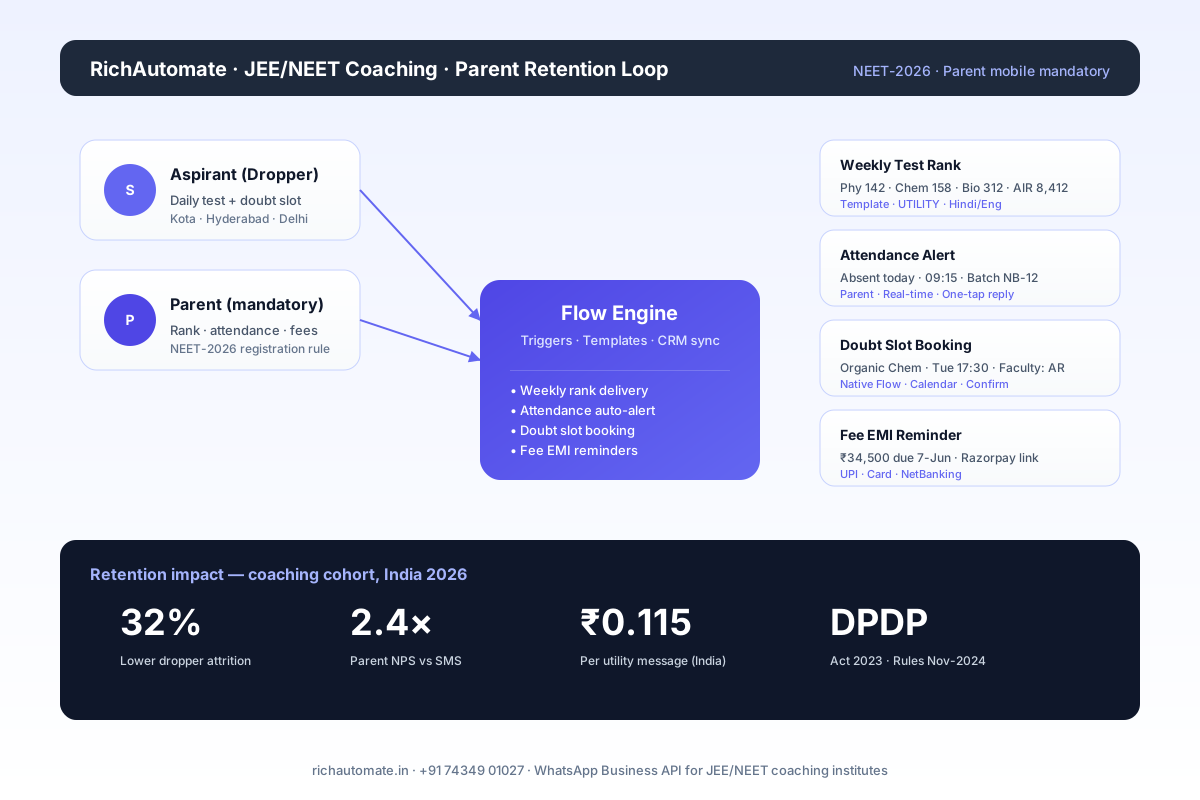
NEET-2026 made parent mobile mandatory at registration. That single rule unlocked an addressable channel coaching institutes never reliably had. Here is the loop — weekly rank, attendance, doubt slots, dropper counselling, fee EMIs — wired to WhatsApp instead of SMS that no one reads.
Why the parent loop matters now — and why it didn't a year ago
India's coaching industry is roughly a ₹50,000-crore market, with the JEE-NEET segment alone driving the bulk of high-ticket admissions across Kota, Hyderabad, Delhi NCR, Vijayawada, Patna, Jaipur, Indore, Coimbatore, and Chennai. For more than a decade the institute's communication was student-first: a paper rank list on the noticeboard, an SMS to the student, a WhatsApp group with 250 unread messages. The parent — the actual fee payer and the actual quit/stay decision-maker — was a phone-call afterthought, reached only when something had already gone wrong.
Two things changed in the last twelve months. NTA made the parent's mobile number a mandatory field at NEET-2026 registration, which means every coaching institute now sits on a clean, verified parent phone list against every aspirant. And the bigger players — PW, Aakash, Allen, Resonance, FIITJEE — moved the post-result counselling rush of 2024 and 2025 onto WhatsApp, training parents to expect institute updates on the messaging app they actually open. The parent is now an addressable channel for the first time. Around 30% of the decision-making messages in a typical coaching cohort route through the parent.
The institutes that wire the parent loop first compound. Each weekly rank delivered to the parent is a fee-renewal nudge. Each attendance alert is an attrition signal caught before it hardens. Each fee EMI reminder is paid 2–3× faster because the parent sees academic context, not a payment screen. The institutes still pushing rank PDFs to the student inbox alone are losing addressable margin every week.
Four scenarios this is built for
1. Weekly test rank delivery — Kota dropper batch
Sunday Part Test at 14:00, results processed by 21:00. The flow node fires a UTILITY template to both student and parent at 21:30 with subject-wise score, AIR equivalent, percentile band, weak-chapters tag, and next test date. Open rate on WhatsApp UTILITY templates for coaching is consistently above 85% — SMS is in the 8–12% range. The same data on a noticeboard in the Landmark City Kota building reaches roughly nobody at home in Bihar by Sunday night.
2. Attendance auto-alert — Hyderabad / Vijayawada day-scholar cohort
Day-scholar attendance is the single biggest hidden leak in Telugu-belt JEE coaching. Aspirant marked absent at the 09:15 biometric scan → flow fires within 4 minutes to the registered parent number with batch code, missed period, and a single-tap reply button ("My child is unwell" / "On leave" / "Call me"). One-tap replies write straight back to the CRM. The centre head sees the daily roll-up at 10:00 instead of finding out at the parent-teacher meeting that the kid skipped twelve classes.
3. Doubt-clearing slot booking — Tier-2 institute differentiator
A Tier-2 institute in Jaipur, Indore, Patna, Bhubaneswar, or Coimbatore can do what PW cannot: route a doubt slot to the actual subject-faculty's calendar. The student picks subject + chapter from a Native Flow dropdown, the engine reads each faculty's availability window, the slot confirmation fires with faculty name visible ("Doubt slot booked with Asst. Prof. R. Sharma, Wednesday 17:30, Organic Chemistry, Room 4B"). Parent gets a copy. The faculty's phone gets the slot. No ticket numbers, no help-desk pretence.
4. Fee EMI reminder + dropper counselling — combined trigger
EMI due 7 June + attendance under 70% in the trailing 30 days → escalation rule fires. Parent gets a single message that opens with attendance and last test rank, then offers a 15-minute counselling slot with the centre head and the Razorpay link for the EMI as a secondary CTA. This is the silent-leaver bucket that costs Kota and Delhi institutes the most every February–May — by the time the parent calls to ask for a fee refund, the decision is already made. This message reaches the parent two weeks before that call.
Flow templates that ship in the Coaching Pack
- Weekly Rank Delivery — UTILITY, bilingual Hindi/English, variable slots for AIR, percentile, weak chapters.
- Attendance Alert (absent today) — UTILITY, fires from biometric webhook, quick-reply buttons write back to CRM.
- Doubt Slot Booking — Meta Native Flow with subject + faculty + calendar conflict-check.
- Dropper Counselling Trigger — composite rule: mock score drop, attendance band, EMI status; routes to centre head.
- Fee EMI Reminder — academic-context-first template, Razorpay UPI/Card/NetBanking link.
- PTM Confirmation — parent-teacher meeting slot booking with faculty calendar.
DPDP Act 2023 for coaching — what most CRMs get wrong
India's Digital Personal Data Protection Act 2023, read with the draft Rules published in November 2024, treats most NEET aspirants as children (under 18). That triggers two specific obligations the coaching sector has been quietly ignoring. First, verifiable parental consent is required to process the child's personal data — not a generic terms-and-conditions checkbox on the admission form. Second, behavioural tracking and targeted advertising directed at children is prohibited; the academic UTILITY loop is permitted because it serves the service the parent signed up for, but bundling marketing into the same consent is the violation pattern most legacy CRMs export.
RichAutomate stores consent string, timestamp, and version against every contact, separates academic UTILITY from marketing opt-in, and supports per-tenant retention windows so you keep data only as long as your auditor and the DPDP principle of storage limitation allow. The Razorpay leg is PCI DSS Level 1 — card and UPI details never touch RichAutomate or your CRM.
Pricing — Coaching Pack
The Coaching Pack is a ₹2,499 / month add-on on the Pro plan. It includes the six pre-approved templates, the Native Flow for doubt-slot booking, biometric webhook ingestion, the composite dropper-counselling trigger, and faculty calendar primitives. Per-message UTILITY is billed at the India card rate (₹0.115 / message as of April 2025), MARKETING at the India MARKETING rate; you only pay for messages that actually deliver. All pricing in INR, GST invoice from a Maharashtra-registered entity, no FX, no USD invoices from a foreign BSP. See the full RichAutomate pricing page for plan comparison.
Ship the parent loop this month — before the JEE-Advanced result cycle
Book a 30-minute call. We map your batches, faculty calendars, biometric system, and Razorpay account live. You leave with a working parent loop and a Meta template review submission already in flight.
Related reading
- JEE/NEET Coaching on WhatsApp — acquisition playbook (India 2026)
- WhatsApp Business API for Indian EdTech (full stack walkthrough)
- DPDP Act 2023 + draft Rules Nov-2024 — what it means for WhatsApp business messaging
- Wati vs RichAutomate — Indian pricing breakdown
- AiSensy vs RichAutomate — UTILITY rate, INR billing, support
- Interakt vs RichAutomate — flow engine + EdTech fit
- Feature template — Native Flow + calendar primitive (used by the doubt-slot booking)
JEE/NEET coaching parent loop · FAQ
Why is the parent suddenly an addressable WhatsApp audience for NEET/JEE coaching in 2026?+
Two shifts happened together. (1) NEET-2026 made parent mobile a mandatory field at registration on the NTA portal, which means coaching institutes finally have a clean, verified parent number against every aspirant — earlier it was a half-filled CRM field. (2) The post-result counselling window of 2024 and 2025 trained parents in Kota, Delhi, Hyderabad, and Vijayawada to expect institute communication on WhatsApp, not SMS. Combined, around 30% of decision-making messages in a coaching cohort now route through the parent, not the student. If you are still pushing rank PDFs to the student inbox alone, you are missing the actual fee-paying decision-maker.
Will Meta approve a UTILITY template that contains a student's test rank and weak chapters?+
Yes — weekly-test-result delivery is a textbook UTILITY conversation under Meta's June 2025 category rules. The template must reference the specific event (test name, date, batch code) and the variable slots must carry the result data. We ship pre-approved templates for "Weekly Rank", "Attendance Alert (absent today)", "Doubt Slot Confirmation", "Fee EMI Due", and "Dropper Counselling Slot". You stay on the cheaper UTILITY rate (₹0.115 / message in India as of the April 2025 rate card) instead of MARKETING (₹0.78), which on a 10,000-student cohort firing once a week is the difference between ₹46k/month and ₹3.1L/month.
How does this work for Kota-style dropper batches where attrition between Feb mock and May main is the killer KPI?+
The dropper-batch loop is the highest-ROI version of this product. Three triggers fire automatically. (1) Mock score drop of more than 15 percentile vs the rolling 4-week mean — counselling slot booking template fires to both student and parent, faculty calendar in the Native Flow. (2) Three consecutive absent days — escalation to assigned mentor + parent call slot. (3) Fee EMI miss + low-attendance combined — flagged to the centre head before the student silently leaves. Kota and Hyderabad institutes that have wired this loop report 25–35% lower February-to-May attrition vs the cohort without the loop.
Is the parent loop DPDP Act 2023 compliant when the student is a minor (most NEET aspirants under 18)?+
Yes, and this is the part most coaching CRMs get wrong. DPDP Act 2023 read with the draft Rules of November 2024 requires verifiable parental consent for processing personal data of children under 18. Since the parent is the legal data principal here, the consent flow is straightforward: the registration form collects parental consent for processing the aspirant's academic data on WhatsApp, the consent string + timestamp + version is stored against the contact, and any later marketing opt-in (separate from academic UTILITY) is captured as a distinct explicit step. We do not bundle the academic loop and the marketing loop into one checkbox — that is the standard DPDP violation in the sector right now.
PW, Aakash, and Allen are sending WhatsApp blasts already — what does a smaller Tier-2 institute do differently?+
Smaller institutes have one big advantage: faculty are addressable. PW cannot put a real subject-teacher into a 4,00,000-aspirant WhatsApp loop. A 600-aspirant Tier-2 institute in Jaipur, Indore, Patna, or Coimbatore can. The flow routes a doubt slot booking directly to the specific faculty's WhatsApp, with calendar conflict-check. Parents see "Doubt slot booked with Asst. Prof. R. Sharma, Wednesday 17:30, Organic Chemistry" — not a generic ticket number. That faculty-name visibility is the moat against the giants, and it is exactly what the Native Flow + calendar primitive was built for.
How are the fee EMI reminders different from a standard Razorpay reminder?+
A Razorpay reminder fires from the payment gateway with a payment link. The RichAutomate fee reminder fires from the academic context — it knows the student is in batch NB-12, attendance is 82%, last test rank was AIR 8,412, and the next EMI of ₹34,500 is due on 7 June. The template is built so the parent sees academic context first, payment link second. Conversion on payment within 24 hours of the message is typically 2–3× a generic gateway reminder, because the parent is being reminded why they are paying, not just that they are paying. Razorpay UPI/Card/NetBanking still does the actual rail.
DPDP-aware by default · INR billed · No USD invoices
Every coaching tenant on RichAutomate ships with parental-consent capture, retention windows, and academic-vs-marketing opt-in separation. Razorpay PCI DSS Level 1 for the fee leg. GST invoice from a Maharashtra-registered Indian entity.