WhatsApp + IRDAI 3-Hour Cashless via NHCX: 2026 Lifecycle
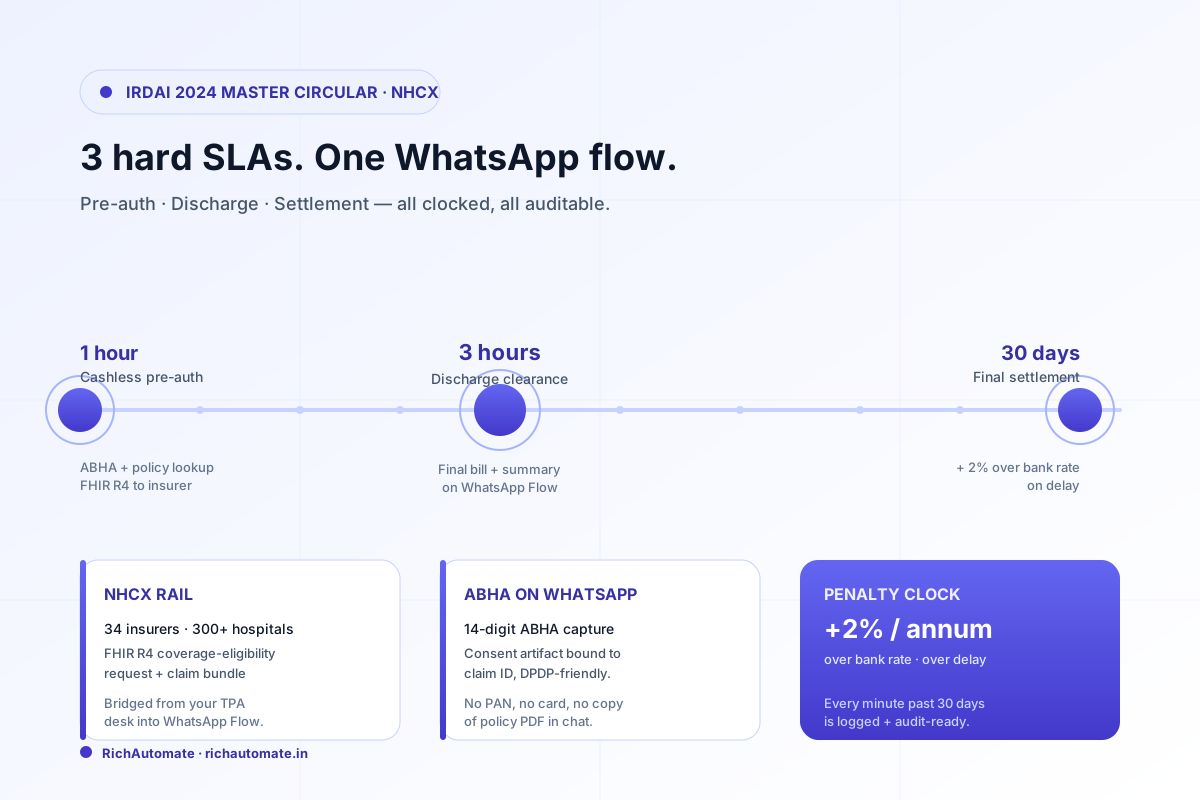
One WhatsApp Flow that hits all three IRDAI SLAs — 1-hour pre-authorisation, 3-hour discharge, 30-day settlement (with 2%-over-bank-rate interest on delay). NHCX FHIR payloads, ABHA-bound consent, audit-ready timestamps.
Why this matters from March 2025 onwards
The IRDAI Master Circular on Health Insurance Business (29 May 2024) flipped a long-standing soft expectation into three hard, clocked obligations. From 2025 every insurer in India has to decide cashless pre-authorisation in 60 minutes, has to issue final discharge clearance in 180 minutes, and has to settle the full claim in 30 days of receiving the last document — and where they fail the 30-day mark, they owe interest at bank rate plus 2 per cent per annum on the delayed amount. A 100 per cent cashless target was layered on top in early 2025. The combination is the single largest operational squeeze on hospital insurance desks and TPAs in the last decade.
The same window saw NHCX — the National Health Claims Exchange run by NHA — cross 34 insurers and 300+ hospitals live, with FHIR R4 bundles replacing PDF email and TPA portal data entry. NHCX gives you the rails. The IRDAI circular gives you the clock. What is still missing in most hospitals is the conversational layer that lets the patient, attendant, insurance coordinator and TPA stay on the same audit trail without phone tag — and that is the WhatsApp piece.
Four scenarios where this stack pays for itself
The workflow looks different on the chat side depending on who is at the keyboard. Four patterns recur across the hospitals we have walked through.
1. Planned admission — Bangalore tertiary care
Patient at Manipal Old Airport Road or Apollo Bannerghatta sends a WhatsApp message 3 days before an elective procedure. The Flow asks for ABHA, policy number, planned date, surgeon. The backend fires a FHIR CoverageEligibilityRequest onto NHCX. Within minutes the insurer responds with eligibility + sum-insured remaining + sub-limits. The 1-hour clock here is the day-of pre-auth, but the eligibility check shaves days of last-minute confusion.
2. Emergency admission — Mumbai Hinduja or Kokilaben
Attendant walks into casualty at 02:14. The insurance desk fires a WhatsApp link to the attendant's phone; the Flow captures ABHA + photo of insurance card. The backend assembles the FHIR pre-auth bundle including ICD-10 codes from the casualty doctor and pushes it onto NHCX. The 1-hour SLA clock starts server-side at NHCX acknowledgement, and the attendant sees a live countdown — not a hand-written estimate at the counter.
3. Discharge with the 3-hour clock — Delhi-NCR Medanta or Max Saket
Discharge summary signed at 10:40. Hospital fires the final-bill bundle on NHCX. The 3-hour clock starts. WhatsApp updates the attendant at the 1-hour, 2-hour and 2-hour-45-minute mark. If the insurer crosses 13:40 without clearance, the IRDAI position is that any further stay is on the insurer's account — and you have a timestamped WhatsApp transcript plus NHCX log to back the position in any escalation.
4. Tier-2 cashless adoption — Indore, Jaipur, Coimbatore
Smaller multi-speciality hospitals that previously ran cashless via TPA portals + fax-quality scans get the most leverage. The WhatsApp Flow + NHCX bundle replaces the 14-page intake form and the FedEx-the-bill close-out. Insurance desk staffing per bed drops; settlement timelines compress; and the 30-day interest clock simply stops being a recurring P&L surprise.
Flow templates included
- Pre-auth Flow — ABHA capture, policy lookup, ICD-10 selection, document upload, NHCX submit, SLA countdown.
- Query response Flow — when the insurer raises a clarification, the Flow asks the desk for the precise document instead of an email volley.
- Discharge Flow — final bill, discharge summary, signed claim form, NHCX final-bundle submit, 3-hour clock.
- Patient status Flow — the attendant can check approval status anytime without re-dialling the insurance desk.
- Internal escalation template — at the 2-hour mark on either SLA, an internal alert fires to the desk supervisor.
DPDP Act 2023 + draft Rules (Nov-2024) posture
Cashless claims are health data, and health data is sensitive personal data under DPDP. The workflow is built so that consent is the gating step, not an afterthought. Each ABHA capture is bound to a specific claim ID, a specific insurer, a specific hospital and a stated purpose. The consent artifact has a timestamp, a purpose string and a revocation handle — the structure the draft DPDP Rules (November 2024) expect when a Consent Manager interacts with a Data Fiduciary. Sensitive documents (policy PDFs, discharge summaries, lab reports) live in an encrypted object store; WhatsApp messages reference them via signed expiring URLs, not raw attachments left in the thread. Retention windows are configurable per data class so you do not over-hold and over-expose.
Pricing
The WhatsApp + NHCX workflow ships on the Pro plan. Hospital and TPA tenants typically run a managed-onboarding engagement (NHCX participant credentials, FHIR mapping, Meta Native Flow review, internal escalation templates) — talk to us for a scoped quote. All pricing is in INR with a GST-compliant invoice. No USD billing, no FX surprises, no per-FHIR-call markup.
Map your hospital onto the 3-hour clock this week
Book a 30-minute call. We walk through your current cashless desk, your NHCX participant status, your TPA mix, and leave you with a concrete Flow + FHIR mapping plan.
Related reading
- WhatsApp + PMJAY / Ayushman cashless workflow (India 2026)
- WhatsApp + IRDAI motor-insurance flows (India 2026)
- India regulation pillar — DPDP, IRDAI, RBI, TRAI in one place
- AiSensy vs RichAutomate — Indian pricing breakdown
- Gupshup vs RichAutomate — enterprise rail comparison
- RichAutomate pricing — Starter, Pro, Chain
IRDAI 3-hour cashless + NHCX · FAQ
What are the exact IRDAI deadlines a hospital WhatsApp workflow must hit in 2026?+
The IRDAI Master Circular on Health Insurance Business (May 2024) sets three hard SLAs that every cashless hospital and insurer must respect from 2025 onwards. First, insurers must decide on a cashless pre-authorisation request within one hour of receiving it. Second, the final discharge authorisation must be issued within three hours of the hospital sending the discharge request — any extra hospital stay caused by insurer delay is to be paid by the insurer, not the patient. Third, the full claim must be settled within 30 days of receiving the last necessary document, failing which the insurer pays interest at bank rate plus 2 per cent per annum on the delayed amount. A WhatsApp + NHCX workflow lets you clock and prove each of these three SLAs in a single audit trail.
How does NHCX actually plug into WhatsApp — is it a direct integration?+
NHCX (National Health Claims Exchange, operated by NHA) is not a chat layer — it is a FHIR R4 exchange that moves CoverageEligibilityRequest, ClaimResponse and related bundles between hospitals, TPAs and insurers. With 34 insurers and 300+ hospitals already live on NHCX, the WhatsApp layer sits on top: the patient or attendant interacts via a WhatsApp Flow (ABHA capture, consent, document upload, status check), the backend translates that into the FHIR payload, fires it onto NHCX, and pushes the response back into the same WhatsApp thread. The patient never sees FHIR. The hospital insurance desk never has to re-key data into a separate TPA portal.
How is ABHA used inside the WhatsApp Flow without breaking DPDP Act 2023?+
ABHA (14-digit Ayushman Bharat Health Account) is captured inside a Meta Native Flow with explicit purpose-limited consent — the patient sees exactly which insurer, which hospital and which claim ID their ABHA is being linked to. Consent artifacts are stored against the claim record with timestamp, purpose, and a revocation handle, which is the structure the draft DPDP Rules (November 2024) expect from a Consent Manager interaction. No policy PDF, PAN, or card image is left lying in the WhatsApp thread — those are fetched on demand from a secure object store with a signed, expiring URL.
What happens if the insurer breaches the 3-hour discharge SLA — does the patient stay stuck at the hospital?+
No, and that is the entire point of the 2024 circular. If the insurer has not issued final discharge clearance within three hours of receiving the request, the additional hospital stay is the insurer's liability, not the patient's. In a WhatsApp + NHCX workflow, the discharge request is timestamped server-side the moment the hospital fires it, the WhatsApp thread shows a live countdown to the patient, and an internal alert template fires to the insurance ops desk at the 2-hour mark. The patient's WhatsApp transcript becomes evidence in any escalation to IRDAI Bima Bharosa.
Which hospital clusters in India are early adopters of WhatsApp + NHCX in 2026?+
NHCX onboarding has clustered around the metro tertiary-care belts first — Bangalore (Manipal, Apollo Bannerghatta, Fortis Cunningham), Mumbai (Hinduja, Kokilaben, Lilavati), Delhi-NCR (Max Saket, Medanta Gurgaon, Fortis Vasant Kunj), Hyderabad (KIMS, AIG Hospitals, Yashoda Somajiguda), Chennai (Apollo Greams Road, MIOT, Kauvery), and Pune (Ruby Hall, Jehangir, Sahyadri). Tier-2 cities — Indore, Jaipur, Lucknow, Coimbatore, Kochi — are the next wave through 2026 H2. The WhatsApp + NHCX workflow is identical across geographies; only the empanelled insurer list differs per hospital.
Is the 30-day clock the only settlement penalty we have to worry about?+
It is the most visible one, but not the only one. Insurers that repeatedly miss the 1-hour pre-auth or 3-hour discharge SLAs are required to disclose grievance and turnaround statistics, and IRDAI has published the structure for hospitals and insurers to file each other for non-compliance. Internally, the WhatsApp + NHCX log gives you per-claim timestamps for received, acknowledged, queried, authorised and settled — which means at the end of the quarter you can produce a defensible report instead of reconstructing data from email threads and Excel sheets.